Bill M216 Submission Deadline Extended

When we use our collective voices and come together in advocacy, we get results.

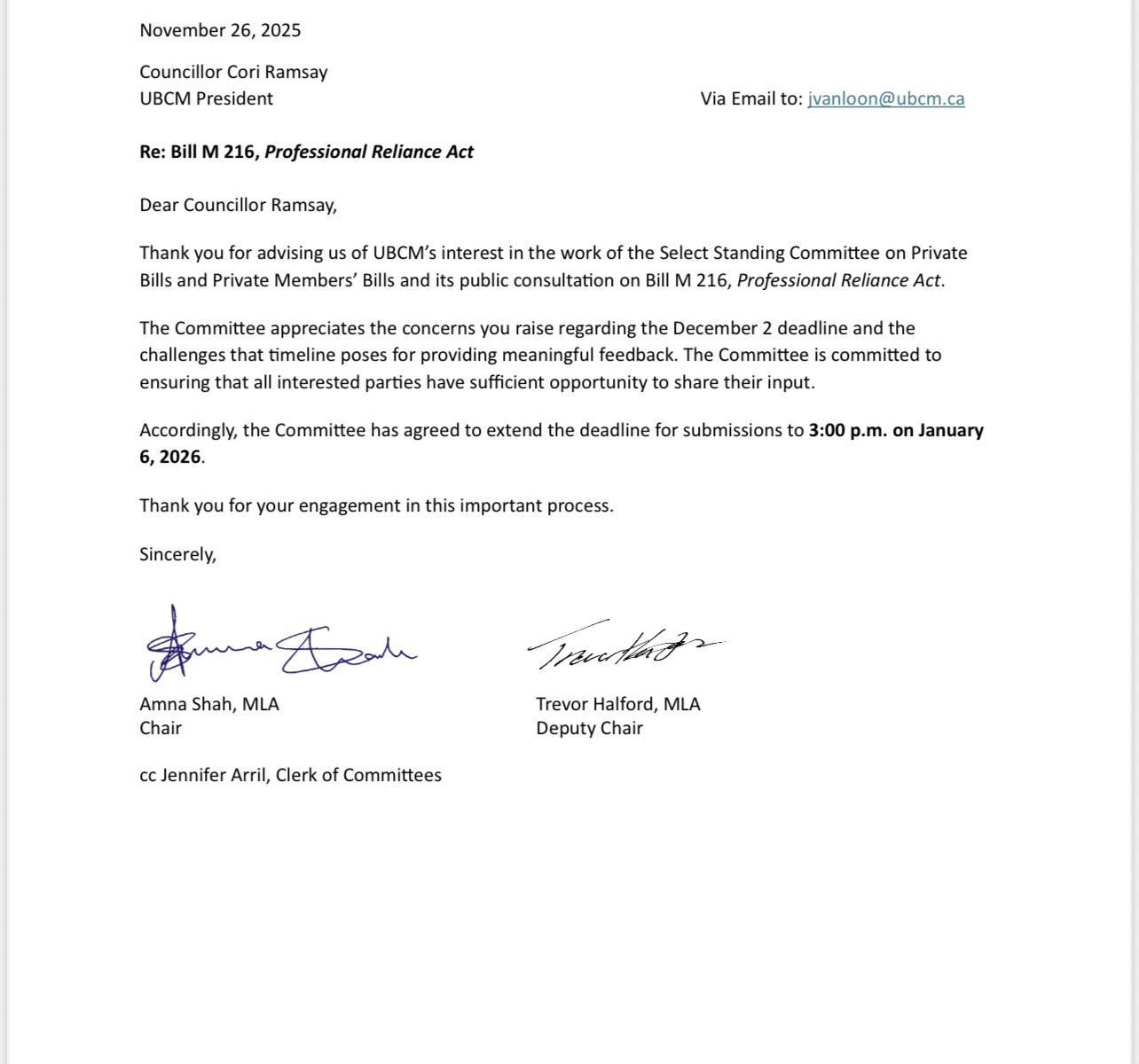
I’m glad to share with you that UBCMs requested extension has been granted for the feedback submission period on Bill M216 until January 6 at 3pm. My thanks to the Standing Committee for considering this request.

Local governments will be deeply impacted by this bill if it proceeds and I want to ensure everyone has time to voice their concerns and perspectives and be heard. That’s why I immediately asked for an extension upon seeding the Dec 2nd deadline, knowing it was not nearly enough time for councils and boards.

Thank you to everyone who has already shared their feedback with the Standing Committee and UBCM – and thank you to those local governments who are diligently working to get their submission in by the deadline.

For those who may not have considered a submission on this private members bill, I would encourage you to learn more about Bill M216 and the consider potential impacts to your local government.

UBCM has released several Compass articles now on Bill M216, including the recent article that came out this morning which can be found here.

If there’s been any confusion about my position on Bill M216, and if you’ve received emails with nuances that I’ve been consulted on this Bill, let me clear it up for the record: UBCM has not been consulted and I am opposed to Bill M216.

Here are a few reasons why:

  • the definition of a PGA professional differs from that of the Community Charter and in a Lidstone & Company legal bulletin, they say the following: “Note that ‘PGA professional’ is a far broader category than the Community Charter’s qualified professional and includes agrologists, science technologists, technicians,
    applied biologists, engineers, geoscientists, forest professionals, and architects. Planners are not included, and many classes of the proposed “PGA Professionals” under Bill M216 have no health and safety expertise regarding matters that would devolve to them under this Act.” I find the expansion of the definition and the allowance of additional professionals without life safety experience deeply concerning, and coupled with an ability to make submission we must accept will bring about significant unintended consequences.
  • Under section 3 of the Bill, developer paid PGA professionals may submit documents that are in contravention of local bylaws and the local government would have to accept documents that violate their own bylaws, or go through dispute resolution.
  • One intent is to remove liability from the local government but local governments will still be named in lawsuits and what happens when the qualified professional does not have the appropriate level of insurance to cover a claim, will local governments be on the hook?
  • Section 5 of the Bill removes the peer review function that exists now between local government planners and developers and would require local governments to do dispute resolution through a superintendent located in Victoria when there is a concern with a submission
  • A superintendents office in Victoria will backlog development and slow down permitting
  • This bill applies to more than zoning permits – and the Lidstone legal brief states: “Professional reliance also applies to building design and construction, subdivision,
    infrastructure design and construction, wildfire or hazard development permits,
    riparian protection, flooding/landslide protection, geotechnical site issues, and
    more.” Again, the peer review function serves a deeper purpose and removing this function with things such as riparian protection and wildfire development permits are on the line – this is removing essential checks and balances.
  • this bill has already passed second reading with zero consultation done with local governments and our input matters. Our staff are knowledgeable professionals with a deep understanding of the local context and excluding their expertise is a grave error in my opinion.
  • Professional reliance is something local governments can already do – if it’s right for the local context – and with proper checks and balances through the peer review process; this bill would move us backwards and regulate professional reliance making it mandatory removing local autonomy and decision making when it comes to land use

I encourage not just local governments, but any impacted stakeholders to utilize this additional time to provide a submission, utilizing the granted extension period. And please, continue to copy UBCM on your submissions so we have a deeper understanding of your views on this Bill.

With gratitude.

Provincial Budget 2025

Today I had the priviledge of attending the Provincial Budget Speech at the Legislature as the UBCM special guest for the Honourable Minister Brittny Anderson. Before I delve into my insights and thoughts on the provincial budget, I wanted to give an update of activities since January.

January

The first two months of the year have flown by so quickly. In January, the City of Prince George hosted the Natural Resources Forum with amazing turnout. Roughly 1,300 participants descended on our community which included many local and provincial government colleagues from across the Province. I was pleased that Premier Eby was able to join us to deliver remarks in person. Additionally, a number of Cabinet Ministers were also able to attend and give remarks.

In January the City of Prince George also deliberated our municipal budget. This was a lengthy debate of almost 18 hours on top of the additional hours each of us spent on our own time reviewing operating and capital budgets. Council settled on a 6.21% tax levy increase. I did write a draft blog on this but couldn’t find time to finalize and publish so I may still try to get that out.

February

February was just as busy with a UBCM executive meeting discussing local government advocacy priorities. Additionally, Council kicked off discussion of first and second reading for our Official Community Plan with the first public hearing scheduled for March 19.

March

This brings us to this first week of March. Yesterday, I had the pleasure of joining the FCM BC Caucus to discuss regional issues and hear from our local government colleagues. Many local governments are concerned over the tariffs and discussing how to prioritize local/regional/Canadian spending.

Provincial Budget

Today, I attended the Provincial budget as an observer from the members gallery. I have never been to a budget announcement so I wasn’t sure what to expect. First, UBCM staffers were included in the Budget Lock-Up – something I feel shows the importance of the relationship. This gave UBCM staff early access this morning to review the budget prior to the announcement which allowed them to publish The Compass immediately following the announcement. The only caveat was sacrificing phones and all technological devices until after the announcement.

I listened intently to Minister Bailey give her remarks and all the while wondering how each aspect of the budget she announced would impact local governments across the province.

Of note was the increased funding for HEART/HEARTH to support communities experiencing homelessness, funding for addiction, treatment and recovery, funding to address the healthcare shortage, as well as funding for community safety to address street disorder and repeat violent offenders. All these items are supported by UBCM resolutions many local governments have been advocating for. Finally, tariffs were a huge topic within the budget and we do not yet know how this will impact the province.

One item I do applaud Minister Bailey for advancing is investment in our tech sector which she has a strong background in. There is a great opportunity to advance tech and open up opportunity across the province (and yes, northern communities still have broadband issues which we bring up often). I am hopeful to see how this evolves.

The opposition was critical of the provincial deficit while also criticizing the government for not putting aside more than $4B in reserves to deal with the tariffs. The opposition also called upon the government to delay the budget given the tariff announcements today.

Following the budget announcement I was able to connect with Premier Eby, and Ministers Bailey and Anderson. I look forward to working with them all and others over the next year in my position on UBCM and on council to make progress on our collective and individual advocacy efforts.

How budget actually shakes out for local governments only time will tell. I for one will be keeping a close eye on the UBCM Compass and the Province to see what happens next.

Why do elected officials go to conferences?

This week, many local government elected officials converge on Vancouver for the Union of British Columbia Municipalities (UBCM) Convention & AGM. You might be asking why do our elected officials go to conferences and what value does this provide my community? This blog is intended to answer that question, and also provide an update on the work being done this week by council.

Resolutions

Resolutions is by far one of the biggest draws for convention and this year there are 267 resolutions being considered by the membership. These resolutions are broken down into several categories such as Special Resolutions, Endorse Block, Not Endorse Block, No Recommendation, and Late/Emergency Resolutions. Within each of these, topics for resolutions include Health & Social Development, Housing, Community Safety, Environment, Regional Districts, Indigenous Relations and Reconciliation, Finance, Land Use, Taxation, Transportation, Legislative, Assessment, Community Economic Development, Elections, and Selected Issues.

A resolutions states a problem and an enactment clause with a proposed solution. The membership debates resolutions under these topics which could include resolutions like Mental Health Supports from the Kootenay Boundary RD, or Incentivizing Non-Market Housing from Maple Ridge, or Management of Fireworks from Mission to name a few. The debate is lively and the resolutions that are passed will form UBCM’s advocacy efforts.

There is immense value in being able to debate, support, and oppose resolutions that would benefit the City of Prince George in our priorities as well as our residents. To view all 2024 resolutions, click here.

Minister Meetings

Throughout the week at UBCM, there will be several opportunities to engage with provincial ministers and their staff. Each community has the opportunity to request meetings; some are approved and some denied. This week we will be meeting with the following to bring forward concerns, requests, thanks and more:

  • Minister Osborne, Energy, Mines, and Low Carbon Innovation
Minister Josie Osborne
  • Minister Fleming, Transportation and Infrastructure
  • Premier David Eby
  • Minister Kahlon, Housing
  • Minister Whiteside, Mental Health and Addictions
  • Minister Ma, Emergency Management and Climate Readiness

The access and opportunity to advocate for our community is unmatched. To be able to meet with these individuals will greatly help to advance our municipal priorities.

Educational Opportunities

UBCM is kind of like the first week of classes at university. There’s a lot going on – in addition to the many panels, workshops, clinics to choose from, there are also many colleagues to meet and learn from.

The start of convention offers incredibly interesting study tours and topics I’ve attended so far include What’s Next For Housing, Communities in Transition: Responding to Change in BC’s Resoirce Sector, and Women Electeds: Finding Solutions Together.

Joel McKay, CEO NDIT

Each day there is something new to choose from including concurrent clinic topics, concurrent workshop topics, keynotes, panels, and the list goes on. Many of these panels consist of colleagues from other local governments sharing solutions they’ve found, programs they’re trialing and expected outcomes, etc.; we also see the province and community partners presenting and sharing updates. We also will hear from provincial party leaders on their priorities for the upcoming year; there are also typically lots of announcements that can impact our communities drastically and being able to hear these announcements in full first hand rather than get drabs from the media is also incredibly beneficial.

UBCM Elections

The UBCM Executive has an incredibly important role. The membership might meet annually, however, the board meets quarterly, has special meetings, advocacy meetings and actions the advocacy priorities determined by the membership. Each quarter, the board meets with the Minister of Municipal Affairs, and at the April meeting, does Advocacy Days in Victoria at the Legislature.

During convention, elections for the board take place and like last year, I will be seeing a second term on the UBCM board as Director At Large to advance our collective priorities.

UBCM President Trish Mandewo

Conclusion

This week is huge for local government and UBCM provides many opportunities to learn, connect, advocate, debate, and more for our communities. The result is strong advocacy from 180+ local governments and First Nations Partners pushing forward for the communities we represent. To me, this is the work we were elected for and I’m incredibly proud of my council as well as local government and First Nations colleagues from across the province on all that we are doing together. So, if you ask me why elected officials go to conferences, I would say we are really there working for you, our residents to build communities you both deserve and desire.

Questions about this blog? Contact me and get in touch and I’d be happy to provide a response.

UBCM Response to Bill 45

It has been a long while since I have written a blog. And I love blogging, like a lot. But in today’s polarizing world, being vulnerable especially about complex problems with varied opinions, is not as easy as it used to be. The backlash seems harsher and yeah, my skin is occasionally thick but most of the time it’s not. So, please be gentle with me as I attempt to blog more.

Last week I attended my first UBCM board meeting of the 2023-2024 term in Vancouver. The UBCM board is an incredible group of elected officials coming together, doing important advocacy for local governments across the province. We have an amazing group elected to the board including our awesome President Trish Mandewo, Councillor for the City of Coquitlam. You can learn more about UBCM on their website here.

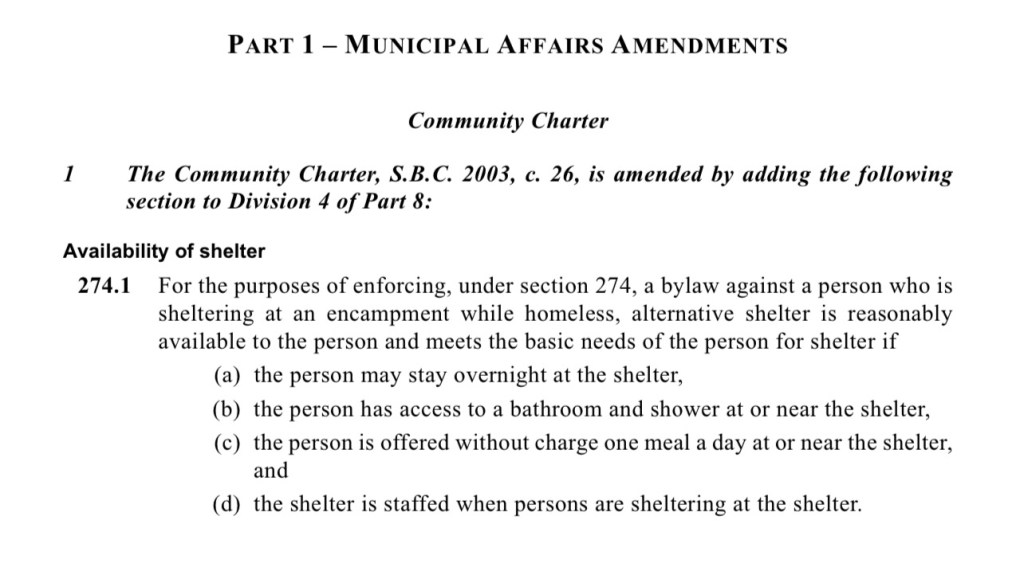
An important topic of conversation was Bill 45 called the Miscellaneous Statutes Amendment Act (No. 4), 2023. This bill makes an amendment to the Community Charter and the Vancouver Charter and basically says that in order to enforce a bylaw against a person who is sheltering in an encampment, local governments will have to ensure alternative shelter is reasonably available.

There are a few problematic issues with this legislation, the main one being that it is being put through some miscellaneous statutes act without local government consultation. And local governments have questions, like what does this mean for how we govern our communities?

There are so many unanswered questions and without doing proper consultation, it is the opinion of many that this piece of legislation does a disservice to everyone in our community. Here’s how President Trish Mandewo put it in her op-ed in today’s edition of the Vancouver Sun:

“This is a lose-lose-lose scenario — for homeless people who need appropriate housing, for residents who are concerned with the fate of so many individuals who have no other choice than to camp, and for local governments which have the responsibility for maintaining parks and public spaces for the use of the community. It does not have to be this way.”

There are many reasons why this legislation needs to be withdrawn and for local government consultation to occur. You can read more about Bill 45 in the full op-ed here.

In addition to Bill 45, there are many important issues facing local governments every day and a lot of that work seems to be incredibly invisible. Know that many of your council members are working hard behind the scenes to find answers to complex questions and a lot of this takes time. And while that time passes, I recognize that residents are becoming increasingly frustrated, and fairly so – you have every right to be frustrated because admittedly, the answers aren’t coming soon enough. And there might not be anything I can say that will lessen that frustration – but know that I continue to work hard on these issues with several of my colleagues locally and across the province. I will continue to answer your questions the best I can, learn, grow and govern in a way that moves us closer and closer to a win-win-win resolution.

Should you have any questions that need answering, or want to provide comments, please feel free to contact me.

Thanks for reading.

A week in the life of a local government elected official

There is no greater week than that of the Union of British Columbia Municipalities (UBCM) convention to demonstrate what it’s like to be a local government elected official. From Minister meetings, to convention plenaries, to networking, here’s my blog covering a week in the life of an elected official.

Minister Meetings

Minister meetings are basically speed-dating sessions with ministers. Every local government – municipality and regional district – asks for a meeting with as many ministers as possible depending on the issues you’re advocating for. When a meeting gets approved, you have twenty minutes to make your pitch. Keep in mind that many other local governments are asking for similar things – funding, support, autonomy, housing, childcare, etc.

Our minister meetings started the Tuesday before UBCM with Minister Whiteside, Minister of Education. Friday was with Minister Mark, Minister of Tourism, Arts, Culture & Sport. Monday morning we met with Premier Horgan, and ended the day with Minister Chen, Minister of State for Child Care. Tuesday through Thursday we attended the BC Liberal Caucus Roundtables on various subjects hosted by Opposition Leader Shirley Bond, and Thursday morning was our final meeting with Minister Osborne, Minister of Municipal Affairs.

Each of these meetings is incredibly important and a lot of research and preparation goes into each meeting. I have so much pride in the work our team does – from staff asking for meetings, preparing briefing notes, to council colleagues showing up to support, and the Mayor pushing hard in those meetings. This is advocacy in action and as someone who loves lobbying – it is my absolute favorite part of the job – I consider it to be one of the most important pieces of work we do to advance issues in Prince George.

UBCM Day 1

During an in-person convention, there are usually tours organized the day before the convention. My first year as a politician I attended Fire Ops and spent a day learning what it means to be a firefighter. We ran into a burning building and pulled out a dummy, used the jaws of life to cut through a car door, and had to crawl through an obstacle course in full firefighter gear. Tours are learning opportunities and are a great way for elected officials to really understand how our decisions impact our communities. Living a day in the life of a firefighter has increased my respect for the work they do to keep our communities safe and has allowed me to better understand how the dollars we annually allocate to the fire department are being utilized.

This year of course, due to the pandemic, there weren’t any tours scheduled but we did get to try out the really cool software called Spatial Chat and hear from four amazing speakers: Jennifer Moss on Post Traumatic Growth; Sheryl Burns & Sharon Gregson on The Future of Child Care; Kendal Netmaker on The Ultimate Resiliency Formula; and finally, Amber Mac on Relentless Adaptation: 4 Tech Trends Accelerating & How to Thrive in Chaos.

The convention officially starts with the Opening Ceremonies. As UBCM is a member driven organization, we start with AGM business approving the budget, the nominating committee report, and appointing the auditors, etc. Next we have an address by the Minister of Municipal Affairs as well as the President of the Federation of Canadian Municipalities (FCM) and then we head into the Community Excellence Awards.

The Community Excellence Awards are always really cool and you get to see innovative projects from other communities. I really appreciated Nanaimo’s Complete Street Engineering Standards and Design Guidelines project, as well as City of Coquitlam’s Community Support and Recovery Plan, and finally the City of Richmond’s Works Yard Recycling Depot Upgrades. Delegates had a lovely Bhangra dance break with Gurdeep Pandher before lunch. After lunch we had a plenary session called Pathways to Truth and Reconciliation with the Honourable Murry Sinclair. I finished the day with a concurrent workshop titled Ensuring Local Government Financial Resiliency.

UBCM Day 2

The morning starts with Resolutions. There are two ways communities can champion resolutions. The first is to send it to their area association (we belong to the North Central Local Government Association) and get the membership to approve it so it already has support at UBCM; or we can send it straight through to UBCM. Prince George had four resolutions:

  • EB10 Increased Capacity at the National Forensic Lab Services
  • EB11 Increasing Capacity in Provincial Court Systems through Alternative Coordinated Initiatives

These two resolutions were part of the Endorse Block (EB) which means the UBCM Resolutions Committee vetted and recommended to approve based on previous resolutions supported by the membership. The next two resolutions had No Recommendation (NR) so our Intergovernmental Resolutions Chair, Councillor Brian Skakun had to debate them on the floor:

  • NR2 Improved Efficiencies in the Prosecution of Criminal Offences
  • NR5 Comprehensive Training Model for RCMP Members

All four of our resolutions were supported by the UBCM membership and will now become part of the advocacy work that UBCM does on our behalf.

My afternoon for day two started with an Address from the Leader of the Opposition, Shirley Bond who did an incredible job. This was followed by a concurrent workshop on Housing Prospects, Key Trends & Key Issues, and then by Global Warming: Lessons from the 2021 Heat Wave. The other two concurrent sessions I missed that were recorded for later viewing include Meeting the Needs: Shared RD Services, and Tourism Recovery Through Collaboration.

UBCM Day 3

Day three starts similarly to Day 2 with a three hour Resolutions Session. I enjoy the art of debate and called in to debate Resolution NR1 Parental Leave for Elected Officials from the Village of Squamish-Lillooet RD. The sponsoring member is a Councillor with a ten day old baby who shares that some elected officials are losing their positions for missing three meetings in a row due to becoming parents. I shared with the membership that it is already hard enough for young people to get elected and if we want diverse voices at our council tables then we have to support resolutions like NR1, not to mention by-elections cost more than paying parental leave so it’s worth looking into. The resolution passes but I am shocked by the number of elected officials opposed and calling into the con line.

I am always impressed by the keynote addresses organized by UBCM. Last year was Margaret Atwood; the year before was Peter Mansbridge. This year was Rick Mercer interviewed by Jody Vance and it did not disappoint. This was followed by an Address from the Leader of the Green Party and then a concurrent session on Modernizing Forest Policy in BC.

UBCM Day 4

The last day of the UBCM Convention was an awesome day. It started with three different town halls delegates could attend, each with several ministers. I attended the session Planning and Building for Growth with Minister Rob Flemming, Minister of Transportation and Infrastructure, Minister Jennifer Whiteside, Minister of Education, Minister David Eby, Attorney General and Minister responsible for Housing, and Minister Adrian Dix, Minister of Health. It was a phenomenal session and delegates were able to ask questions. My question of Minister Eby on complex care was asked and I am so hopeful to see how this new form of housing makes a difference in the lives of our vulnerable populations. We will be advocating hard to Northern Health and BC Housing for this housing – which really seems to understand that people need more support than what supportive housing can offer – to be implemented in Prince George. Finally, the convention ended with an address by the Premier where delegates were able to engage and ask questions of the Premier.

Conclusion

The UBCM, FCM, and NCLGA conventions are an incredibly important part of the work we do as local government elected officials for our communities. Not only do these conventions serve as educational opportunities – as opportunities to share and learn from one another – they are also hubs for networking and advocacy and meeting and interacting with important community partners. A lot of what we do seems to be invisible work. Constituents don’t always get to see what’s behind the curtain so I wrote this blog so you can better understand what goes into the advocacy work we do for our communities.

The work doesn’t stop here. UBCM is an important part of our advocacy work but this is just one piece of the advocacy puzzle. Later this month, council will go into our strategic planning session and determine our strategic priorities for the year ahead. We will set smart goals and evaluation criteria and this will, in effect, direct the staff workplan. We have already started working on Resolutions for next years convention. Additionally, as the President of NCLGA, I am now a director with UBCM and I cannot wait for my first board meeting in November when I will be appointed to committees and continue the advocacy work for the greater good of our BC municipalities.

If you ever see a piece of policy that you believe is not working for our community, be sure to send correspondence to council and tell us about it. We have the ability to refer issues to our Intergovernmental Resolutions committee to add to their workplan and investigate/advocate for meaningful change on the issues that impact our community.

Thank you for reading through a week in the life of a local government elected official. As always, if you have any questions, please feel free to reach out to me through my contact page.