When we use our collective voices and come together in advocacy, we get results.
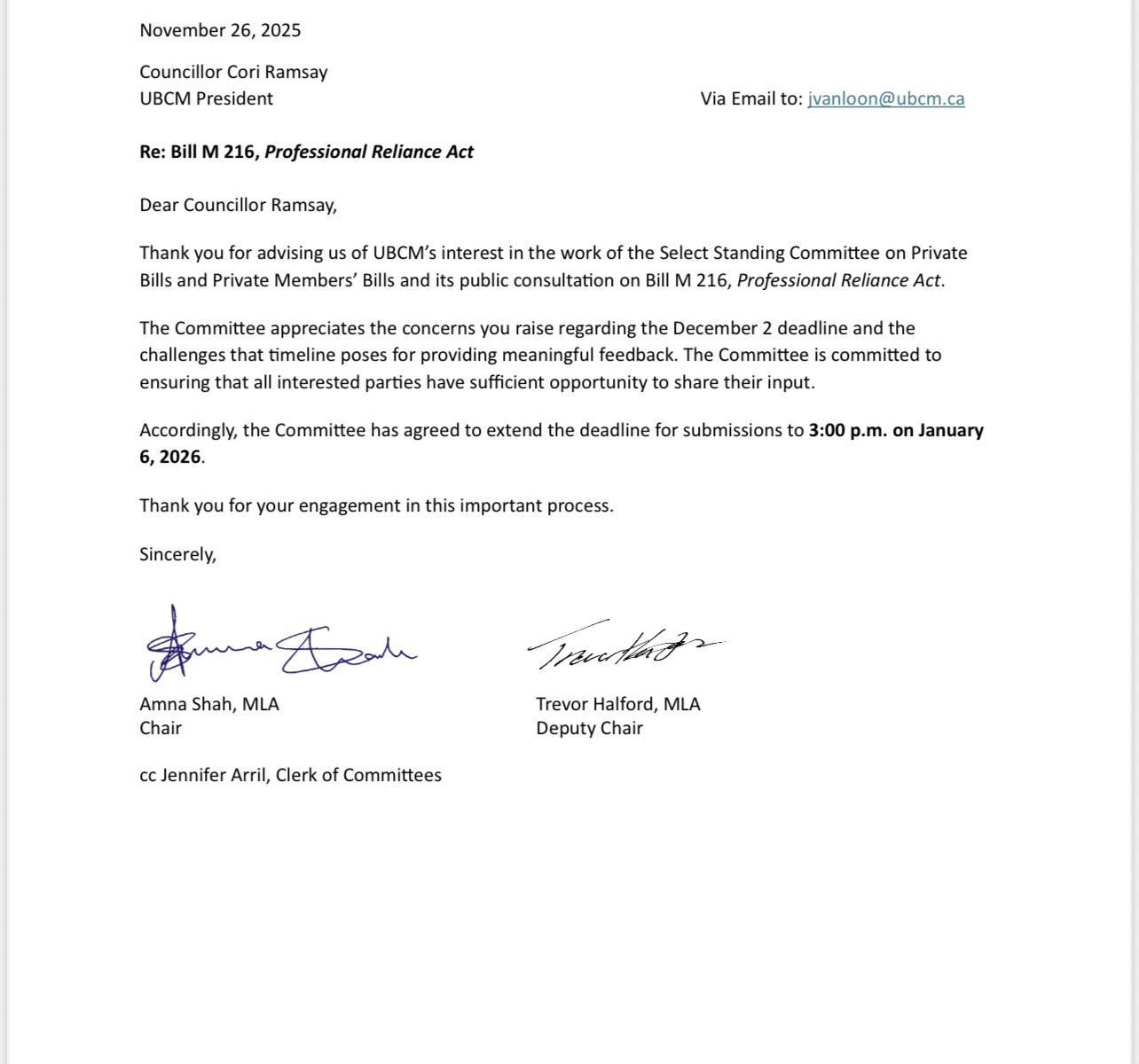
I’m glad to share with you that UBCMs requested extension has been granted for the feedback submission period on Bill M216 until January 6 at 3pm. My thanks to the Standing Committee for considering this request.
Local governments will be deeply impacted by this bill if it proceeds and I want to ensure everyone has time to voice their concerns and perspectives and be heard. That’s why I immediately asked for an extension upon seeding the Dec 2nd deadline, knowing it was not nearly enough time for councils and boards.
Thank you to everyone who has already shared their feedback with the Standing Committee and UBCM – and thank you to those local governments who are diligently working to get their submission in by the deadline.
For those who may not have considered a submission on this private members bill, I would encourage you to learn more about Bill M216 and the consider potential impacts to your local government.
UBCM has released several Compass articles now on Bill M216, including the recent article that came out this morning which can be found here.
If there’s been any confusion about my position on Bill M216, and if you’ve received emails with nuances that I’ve been consulted on this Bill, let me clear it up for the record: UBCM has not been consulted and I am opposed to Bill M216.
Here are a few reasons why:
the definition of a PGA professional differs from that of the Community Charter and in a Lidstone & Company legal bulletin, they say the following: “Note that ‘PGA professional’ is a far broader category than the Community Charter’s qualified professional and includes agrologists, science technologists, technicians, applied biologists, engineers, geoscientists, forest professionals, and architects. Planners are not included, and many classes of the proposed “PGA Professionals” under Bill M216 have no health and safety expertise regarding matters that would devolve to them under this Act.” I find the expansion of the definition and the allowance of additional professionals without life safety experience deeply concerning, and coupled with an ability to make submission we must accept will bring about significant unintended consequences.
Under section 3 of the Bill, developer paid PGA professionals may submit documents that are in contravention of local bylaws and the local government would have to accept documents that violate their own bylaws, or go through dispute resolution.
One intent is to remove liability from the local government but local governments will still be named in lawsuits and what happens when the qualified professional does not have the appropriate level of insurance to cover a claim, will local governments be on the hook?
Section 5 of the Bill removes the peer review function that exists now between local government planners and developers and would require local governments to do dispute resolution through a superintendent located in Victoria when there is a concern with a submission
A superintendents office in Victoria will backlog development and slow down permitting
This bill applies to more than zoning permits – and the Lidstone legal brief states: “Professional reliance also applies to building design and construction, subdivision, infrastructure design and construction, wildfire or hazard development permits, riparian protection, flooding/landslide protection, geotechnical site issues, and more.” Again, the peer review function serves a deeper purpose and removing this function with things such as riparian protection and wildfire development permits are on the line – this is removing essential checks and balances.
this bill has already passed second reading with zero consultation done with local governments and our input matters. Our staff are knowledgeable professionals with a deep understanding of the local context and excluding their expertise is a grave error in my opinion.
Professional reliance is something local governments can already do – if it’s right for the local context – and with proper checks and balances through the peer review process; this bill would move us backwards and regulate professional reliance making it mandatory removing local autonomy and decision making when it comes to land use
I encourage not just local governments, but any impacted stakeholders to utilize this additional time to provide a submission, utilizing the granted extension period. And please, continue to copy UBCM on your submissions so we have a deeper understanding of your views on this Bill.
Skewer me if you want, but at least be informed when doing it.
Some members of the public seem to be very angry over a motion I recently moved and have made the assumption that I have removed very important public reporting – removing quarterly council expense reporting – this is not true so let me clear up the confusion.
What happened?
Every year in June, council reviews our Statement of Financial Information colloquially referred to as the SOFI report. This report contains all legislatively required reporting on things like salaries and expenses for employees earning over $75,000. Every employee that meets this criteria are listed on this report for the public to review and provide comment on. This report also includes things like council expenses (including who did and who did not go over their allocated budget), contracts over $75,000 and much more. It typically receives much attention and if you’ve never reviewed it, I’d recommend checking out the 2024 version here.
At the June meeting, while reviewing the SOFI report, a member of council, without a notice of motion, put forward the following resolution:
That council directs administration to report to council on expenses in the same manner as the council currently reports of the city manager, directors, the manager of legislative services, and the deputy corporate officer on a biannual basis.
Council is a governance board, not an operating board, and by legislation, operational duties of the city are delegated by council to the city manager, which includes oversight of employee expenses. Under the one employee model, council reviews the city managers expenses and the city manager reviews employee expenses. It’s a pretty straight forward governance practice.
I opposed the original motion because I felt this was redundant due to the SOFI reporting already providing this information, and also, this to me is overstepping our governance role and delving into operations. I felt that with only 9 employees identified in the motion being required to do additional reporting, this would create some public criticism into things like professional development training these individuals are taking; it would impact morale due to public scrutiny of only some employees receiving additional twice yearly criticisms over spending that has been approved in the budget set by council. Finally, as Prince George is the only municipality in all of BC to adopt this practice, I also worried that this would impact our recruiting efforts and succession planning. Despite my objections, the motion narrowly passed.
Fast forward to Monday’s meeting – where we for the first time reviewed the actual reporting that came about as a result of councils motion. I found some red flags and discrepancies in the report. For example, members of council attended the FCM conference in May bringing with us the city manager and our Director of Development Services. While the City Manager and Director had these expenses listed publicly in this report, it does not show the full picture and is very misleading to the public because there was also another employee who attended the conference who was not required under this reporting process to report expenses. For the record, all employees earning over $75,000 already have their expenses publicly reported in the SOFI report.
Why are council expenses shared on an open meeting agenda?
Let me explain it this way: if you were to review the organizational structure of the city, you would see that employees report to the city manager – who reviews employee expenses; the city manager reports to council – who reviews the city managers expenses; and council reports to the tax payers – who review our expenses. I want to state for the record that I firmly believe that it is important for the public to be able to review our expenses as members of council and I have not removed this reporting – this is still in place. I think it is important for you to see which of us is over and under on our expense budgets because we ultimately report to you. That is transparency and accountability in action and all members of council report our full quarterly expenses on the quarterly report – not a subset of members unlike the motion which asked that only 9 specific staff members share their expenses in addition to the already public reporting in the SOFI report.
I do want to add some commentary around transparency because this word is thrown around a lot and sometimes even weaponized. I know full well that residents want full transparency on every single decision we make, and the rhetoric in this era of distrust typically indicates that you don’t have full transparency unless you yourself get to delve into the general ledger lines of every single dollar we spent because seeing is believing. The reality is that council from time to time has to deal with confidential information as any business does. There is an extraordinary cost to the taxpayers if the city were to not keep information confidential when appropriate. New businesses looking to come to the city wouldn’t trust us, our position on certain matters could be strategically jeopardized, the province would very likely stop giving us grant funds, special and major events would be jeopardized, and we could potentially open ourselves up to a lawsuit – these are just some examples that come to mind.
So how do we ensure the public gets accountability when they don’t fully see everything? For me, this is my role as a councillor. You have elected me to be your eyes in the open and closed meetings and I greatly enjoy being your little truffle pig, sniffing out the goods and getting what I believe is the best outcome for residents.
Getting back to the motion. It should be noted that if council wants to discuss an individual line item in the SOFI report, it must be moved to the closed council meeting because it then becomes subject to PIPA and is considered personal information protected by legislation. I would opine that this additional redundant report could potentially breech PIPA and put us at risk.
So what exactly did I change that was supported by a majority of council?
I reviewed the report on staff expenses for Q1 and Q2 and determined that it was very lacking because we already get a more fulsome report with so much more information – and hey, everyone who is supposed to be on it, is on it. I still wanted to respect the original motion that was put forward so I suggested a change in council direction that upheld our position as a governance board. Rather than reviewing this secondary report in an open meeting with only 9 staff, I proposed that we review the city managers expenses in the closed meeting and direct the city manager to review staff expenditures regularly. This maintains good governance ensuring council is not delving into operations, and still gives council the opportunity to review expenses and ask pointed questions – your elected eyes doing their job.
To sum it up: the public already gets a much better report publicly sharing information on staff expenses. The new additional report that didn’t really show anything and was quite misleading has been removed and instead, the city manager will share his expenses in a closed council meeting regularly with council.
If you have questions or need further clarification, please get in touch – you can find info on my contact page. I am more than happy to discuss and clarify to ensure you feel as confident as I that this decision was in the best interest of the city.
Today I had the priviledge of attending the Provincial Budget Speech at the Legislature as the UBCM special guest for the Honourable Minister Brittny Anderson. Before I delve into my insights and thoughts on the provincial budget, I wanted to give an update of activities since January.
January
The first two months of the year have flown by so quickly. In January, the City of Prince George hosted the Natural Resources Forum with amazing turnout. Roughly 1,300 participants descended on our community which included many local and provincial government colleagues from across the Province. I was pleased that Premier Eby was able to join us to deliver remarks in person. Additionally, a number of Cabinet Ministers were also able to attend and give remarks.
In January the City of Prince George also deliberated our municipal budget. This was a lengthy debate of almost 18 hours on top of the additional hours each of us spent on our own time reviewing operating and capital budgets. Council settled on a 6.21% tax levy increase. I did write a draft blog on this but couldn’t find time to finalize and publish so I may still try to get that out.
February
February was just as busy with a UBCM executive meeting discussing local government advocacy priorities. Additionally, Council kicked off discussion of first and second reading for our Official Community Plan with the first public hearing scheduled for March 19.
March
This brings us to this first week of March. Yesterday, I had the pleasure of joining the FCM BC Caucus to discuss regional issues and hear from our local government colleagues. Many local governments are concerned over the tariffs and discussing how to prioritize local/regional/Canadian spending.
Provincial Budget
Today, I attended the Provincial budget as an observer from the members gallery. I have never been to a budget announcement so I wasn’t sure what to expect. First, UBCM staffers were included in the Budget Lock-Up – something I feel shows the importance of the relationship. This gave UBCM staff early access this morning to review the budget prior to the announcement which allowed them to publish The Compass immediately following the announcement. The only caveat was sacrificing phones and all technological devices until after the announcement.
I listened intently to Minister Bailey give her remarks and all the while wondering how each aspect of the budget she announced would impact local governments across the province.
Of note was the increased funding for HEART/HEARTH to support communities experiencing homelessness, funding for addiction, treatment and recovery, funding to address the healthcare shortage, as well as funding for community safety to address street disorder and repeat violent offenders. All these items are supported by UBCM resolutions many local governments have been advocating for. Finally, tariffs were a huge topic within the budget and we do not yet know how this will impact the province.
One item I do applaud Minister Bailey for advancing is investment in our tech sector which she has a strong background in. There is a great opportunity to advance tech and open up opportunity across the province (and yes, northern communities still have broadband issues which we bring up often). I am hopeful to see how this evolves.
The opposition was critical of the provincial deficit while also criticizing the government for not putting aside more than $4B in reserves to deal with the tariffs. The opposition also called upon the government to delay the budget given the tariff announcements today.
Following the budget announcement I was able to connect with Premier Eby, and Ministers Bailey and Anderson. I look forward to working with them all and others over the next year in my position on UBCM and on council to make progress on our collective and individual advocacy efforts.
How budget actually shakes out for local governments only time will tell. I for one will be keeping a close eye on the UBCM Compass and the Province to see what happens next.
This week, many local government elected officials converge on Vancouver for the Union of British Columbia Municipalities (UBCM) Convention & AGM. You might be asking why do our elected officials go to conferences and what value does this provide my community? This blog is intended to answer that question, and also provide an update on the work being done this week by council.
Resolutions
Resolutions is by far one of the biggest draws for convention and this year there are 267 resolutions being considered by the membership. These resolutions are broken down into several categories such as Special Resolutions, Endorse Block, Not Endorse Block, No Recommendation, and Late/Emergency Resolutions. Within each of these, topics for resolutions include Health & Social Development, Housing, Community Safety, Environment, Regional Districts, Indigenous Relations and Reconciliation, Finance, Land Use, Taxation, Transportation, Legislative, Assessment, Community Economic Development, Elections, and Selected Issues.
A resolutions states a problem and an enactment clause with a proposed solution. The membership debates resolutions under these topics which could include resolutions like Mental Health Supports from the Kootenay Boundary RD, or Incentivizing Non-Market Housing from Maple Ridge, or Management of Fireworks from Mission to name a few. The debate is lively and the resolutions that are passed will form UBCM’s advocacy efforts.
There is immense value in being able to debate, support, and oppose resolutions that would benefit the City of Prince George in our priorities as well as our residents. To view all 2024 resolutions, click here.
Minister Meetings
Throughout the week at UBCM, there will be several opportunities to engage with provincial ministers and their staff. Each community has the opportunity to request meetings; some are approved and some denied. This week we will be meeting with the following to bring forward concerns, requests, thanks and more:
Minister Osborne, Energy, Mines, and Low Carbon Innovation
Minister Josie Osborne
Minister Fleming, Transportation and Infrastructure
Premier David Eby
Minister Kahlon, Housing
Minister Whiteside, Mental Health and Addictions
Minister Ma, Emergency Management and Climate Readiness
The access and opportunity to advocate for our community is unmatched. To be able to meet with these individuals will greatly help to advance our municipal priorities.
Educational Opportunities
UBCM is kind of like the first week of classes at university. There’s a lot going on – in addition to the many panels, workshops, clinics to choose from, there are also many colleagues to meet and learn from.
The start of convention offers incredibly interesting study tours and topics I’ve attended so far include What’s Next For Housing, Communities in Transition: Responding to Change in BC’s Resoirce Sector, and Women Electeds: Finding Solutions Together.
Joel McKay, CEO NDIT
Each day there is something new to choose from including concurrent clinic topics, concurrent workshop topics, keynotes, panels, and the list goes on. Many of these panels consist of colleagues from other local governments sharing solutions they’ve found, programs they’re trialing and expected outcomes, etc.; we also see the province and community partners presenting and sharing updates. We also will hear from provincial party leaders on their priorities for the upcoming year; there are also typically lots of announcements that can impact our communities drastically and being able to hear these announcements in full first hand rather than get drabs from the media is also incredibly beneficial.
UBCM Elections
The UBCM Executive has an incredibly important role. The membership might meet annually, however, the board meets quarterly, has special meetings, advocacy meetings and actions the advocacy priorities determined by the membership. Each quarter, the board meets with the Minister of Municipal Affairs, and at the April meeting, does Advocacy Days in Victoria at the Legislature.
During convention, elections for the board take place and like last year, I will be seeing a second term on the UBCM board as Director At Large to advance our collective priorities.
UBCM President Trish Mandewo
Conclusion
This week is huge for local government and UBCM provides many opportunities to learn, connect, advocate, debate, and more for our communities. The result is strong advocacy from 180+ local governments and First Nations Partners pushing forward for the communities we represent. To me, this is the work we were elected for and I’m incredibly proud of my council as well as local government and First Nations colleagues from across the province on all that we are doing together. So, if you ask me why elected officials go to conferences, I would say we are really there working for you, our residents to build communities you both deserve and desire.
Questions about this blog? Contact me and get in touch and I’d be happy to provide a response.
A couple weeks ago, the City launched the #BeDowntown campaign, a video campaign which shares authentic stories about our downtown. It’s real people sharing stories that aren’t sugar coated. It acknowledges the issues but also reminds us that there are a lot of good businesses downtown that need our support. I shared this campaign on reddit a few weeks ago and it wasn’t well received. People wanted more than a marketing campaign and I’m happy to share that after a significant amount of work, Downtown Prince George, the PG Chamber of Commerce, Tourism Prince George, and the City of Prince George have launched our new Downtown Strategy. These four groups will be leading the Downtown Strategy Team in consultation with many different user groups as it relates to each of the recommendations.
The Strategy & The Team
Spring last year, council did an info session with the consultants that Downtown Prince George had hired to work on a downtown strategy. They walked us through their process for consultation and asked us questions in a focus group type setting about what we envisioned for our downtown. This was one of many focus groups ran as they worked to better understand what our collective vision is for our downtown. The strategy that was shared at council last night feels like a true representation of our collective vision.
The strategy starts by sharing it’s objectives: develop a unique positioning, identify future trends, establish growth opportunities, action recommendations. It then proceeds to go into a situational analysis of our opportunities and challenges, shares the vision, target audiences, and recommendations.
When looking at the current perception of downtown, I can say that I’ve heard all these things listed below and it rings true to me. Many go downtown to eat, shop and work but would agree with it having low livability. A personal hope of mine is that rather than developers targeting seniors for downtown housing projects who might not want to live right downtown, they instead target young people and help them start building equity in an affordable multifamily developments – but that’s another convo for another day when the OCP consultation is done.
Vision
What does the vision for downtown Prince George look like? The first statement in the vision states: “Downtown Prince George is the city’s cultural and business heart, a destination and gathering place for local and visitors and a preferred location for businesses.” When I personally think of our downtown, I think about a kitchen with a big table where family sits to share a meal, play games, work on business proposals or plans or just do work or homework – and so this idea of downtown being a gathering place for culture and business resonates with me deeply.
Recommendations
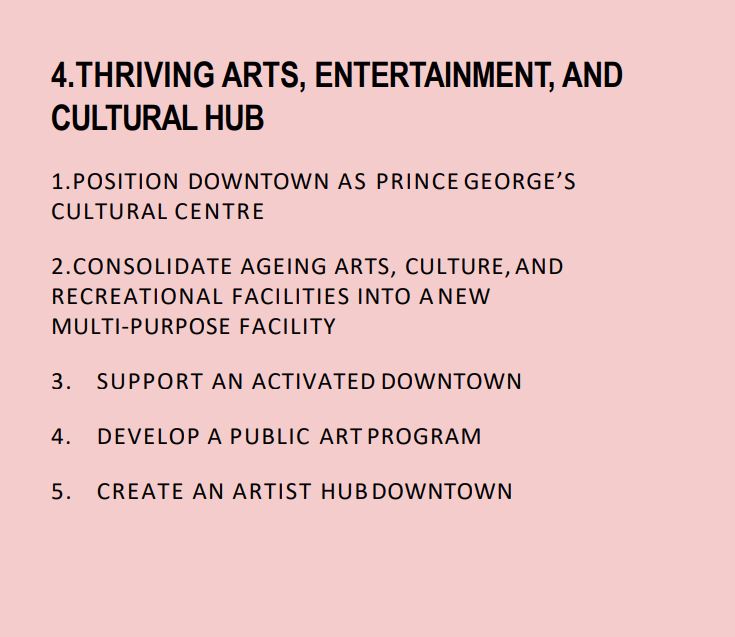
Before we get into the recommendations, the consultants have identified six downtown development principles which I think are worth mentioning because the downtown’s that I love exhibit all of these principles. Mixed-use downtown is something many residents have called for so it’s no surprise to see that in there. A Thriving Arts, Entertainment, and Cultural Hub – last term former Councillor Terri McConnachie and myself did a public art tour while at the FCM convention in Quebec City. This tour was amazing and they really showcased how public art, entertainment, and culture is an attractant for young people to a city. The point often gets brought up that we don’t do a good job of keeping graduates in Prince George despite having a university and a college. Investing in arts, entertainment and culture is something that I firmly believe will change that (in addition to other things like affordable housing options).
Under each of these principles, we see associated recommendations:
Next Steps
The Downtown Strategy Team is launching as the first step of this strategy and they will be bringing an update to council at the end of Q2 (June) so please stay tuned for that. Some will buy-in to the new strategy like me, but I also know that others will likely be more hesitant and that is a very natural response to change. What I ask is this: Please read through the plan, see it’s intentions, and give it a chance to transform our downtown. The work will likely be slower than you want mostly because changing opinions is the hardest type of change to bring about (at least in my opinion) but I am confident that supporting this strategy will result in positive change to our downtown.
If you want to send your thoughts on the new downtown strategy, feel free to send an email to Mayor and Council or a letter of correspondence for our next council agenda. You can comment on this blog or get in touch with me as well. Thanks for reading!
I wanted to write a blog on budget last week but then I had the Regional District budget and regular meetings so unfortunately it’s a little delayed but hopefully you find the information helpful.
I’ll start by saying that there is a lot of work that goes into the city budget and the process for the 2024 budget kicked off in August 2023 at the Finance and Audit (F&A) Committee which I chair and consists of Councillors Bennett, Polillo and Klassen. At the August meeting, F&A reviewed the budget consultation approach and made a recommendation to council (committee’s do not have the ability to make decisions on their own so we make recommendations to council and they can choose to adopt, amend, or halt a process) on the process which was approved.
Budget Consultation 2024
Our budget consultation included a number of engagement opportunities. The City of Prince George ran five satisfaction surveys on: roads and sidewalks, parks and trails, events and recreation, snow and ice control, and protective services. Each survey had between 200-300+ responses. We also ran 24 social media posts asking for feedback on various topics which generated hundreds of comments. Citizen Budget, which some might be familiar with, is a survey we run every year as part of our budget consultation and saw 1,500 visitors in 2023. Finally, council also put on three public input sessions in the Hart, Downtown and in College Heights to hear feedback in-person from residents. Budget consultation runs throughout October every year and there are many ways to engage and tell us what you think. Members of the public can also email council or send letters of correspondence. Overall, I think we have a robust engagement process that considers feedback from different mediums and sources. If you think this process can be improved upon, please let me know your thoughts!
What We Heard
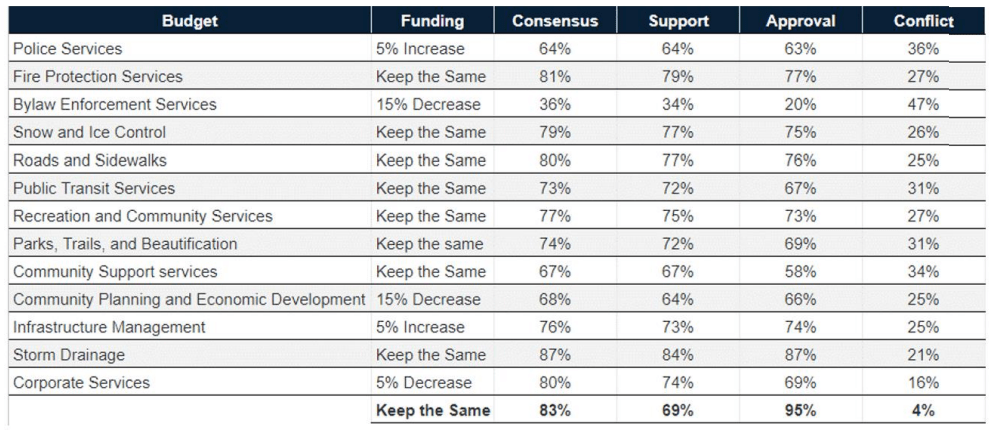
There’s a lot of information and feedback to sift through but below shows the Citizen Budget survey results (keeping in mind that there is a lot of info collected in addition to this like the other surveys and social media comments but this does summarize for the sake of a blog a general idea of feedback from the public). You can view the entire results of the budget engagement here at item D.1.
Looking at the table below, we can see that residents have asked for increases and decreases in specific areas, but overall 83% asked that service levels remain the same. Considering inflation was at 3.4% in December, to keep service levels the same, we are automatically without changes looking at the inflationary increase. Now, 3.4% is much different than the 6.24% which includes some increases, but it equally important to note that the 3.4% inflation rate is based on a basket of goods that includes household items, not things like construction materials and asphalt so the inflation rate for municipalities tends to be higher.
There are other factors that require us to consider differing from the feedback in the Citizen Budget results. An example of this is Fire Protection Services which saw five new firefighters and one new admin added as an enhancement. This was due to a report council received in March 2023 which you can view here at C.1 which can be summed up as: “Following through on the 5-year staffing plan will bring the Fire Department within compliance of NFPA 1710, ensuring the appropriate number of firefighters on scene to fight residential structure fires in the recommended length of time.” So that for me was a very good reason to differ from the public recommendation of ‘keep the same’ given that not following this recommendation could have liability issues and impact life saving measures by our fire department.
The Financial Plan
The financial plan – which is the operating budget – is very complex and sometimes it’s not the easiest to understand so I’m going to try and break it down in what I hope is an adjustable format. Essentially, this is a $166.4M budget and a 1% increase is equal to $1,292,482. The $166.4M amount excludes the additional $59.7M we collect for other agencies such as the School District, the Regional District, 911, the Regional Hospital, BC Assessment, etc. which you will see on your tax bill.
Over all, the tax levy is made up of four individual levies:
The first levy is General (operating) which consists of the operating funding for all city services except for off street parking, snow, solid waste, sewer, water, and district energy because they have their own fund which collects their operating monies. The general levy collected $110,398,156 in 2023 and saw a 4% increase in 2024 bringing it to $116,396,345 for 2024.
The second levy is General Infrastructure Reinvestment Fund (GIRF). This levy was started in 2016 when council realized we had a significant infrastructure funding gap we needed to close. Since 2016, this fund has grown to $2,950,000 but with minor contributions of between $50,000-$75,000 over the past several years, we know that it is not enough to fund future capital projects. Earlier this year a recommendation was passed in our Finance Policy that would see 1% of the tax levy will be set aside to fund GIRF. Within the tax levy you will see that 1%, or $1,292,482 which brought GIRF from the $2,950,000 to $4,242,482 in this budget cycle. Now we might not need to fund GIRF at this level forever, but several years at 1% until the funding gap is closed will be necessary to fund our future infrastructure reinvestment needs.
The third levy is Snow. We collected $9.8M in 2023 and the 2024 budget saw a recommended increase of $1M ensuring we keep a healthy reserve of 25% of the snow budget so that if we have a snowpocalypse event (or many) we can use the reserve to cover any overages. This recommendation, if approved, would have brought the snow levy to $10.8M in 2024.
The final levy is Road Rehabilitation which collected $6.1M in 2023 and had a recommended increase of $600,000 in 2024. This lets us complete 50 lane km’s in the city every year. At F&A we did hear that asphalt is seeing a huge inflationary increase meaning that the city could see the $141 per ton rate increase to $200 per ton for smaller jobs. F&A passed a recommendation that council consider an enhancement in the amount of $300K which would bring the overall levy with the proposed increase to $7M. This would still bring us short of our infrastructure funding gap by $1.2M.
With all that, not including the enhancements, the proposed tax levy was at 6.24%. Council made some changes to the proposed budget from staff. Rather than increase snow by $1M, we chose to increase by $500K which would still fund the levy but have us rely on the reserve in 2024 should we see significant snowfall activity. Service levels to snow removal have not been changed so this means using the savings we have in the bank to fund the bill if we go over the $10.3M budget. We also saw proposed changes by colleagues that did not pass.
What does 0% look like?
As we go through the 2024 and previous budgets, thinking about that 1% = $1,292,482 (in 2024) is an important consideration, for me at least. People often ask the question, why can’t we have a 0% increase? To get to 0% would require council to cut $8,065,087.68 in the 2024 budget. To cut that amount would mean residents would experience significant impacts to service levels across multiple divisions.
But we had a 0% in a covid year? Yes, we technically had a 0% tax levy in 2021 followed by 3.00% in 2022 and 7.58% in 2023. Now we have 6.78% in 2024 and likely several years of mid-5-6% increases where we are recovering from the 0%. This is because to get to 0%, council did not cut services and instead used a one-time funding source (the COVID-19 Safe Restart Grant), to fund the inflationary increase meaning that once the one-time money was no longer available, we had to fund it through the levy. I did not support the 0% for this reason and it is my opinion that we will be recovering from the 0% for quite some time.
Capital Plan
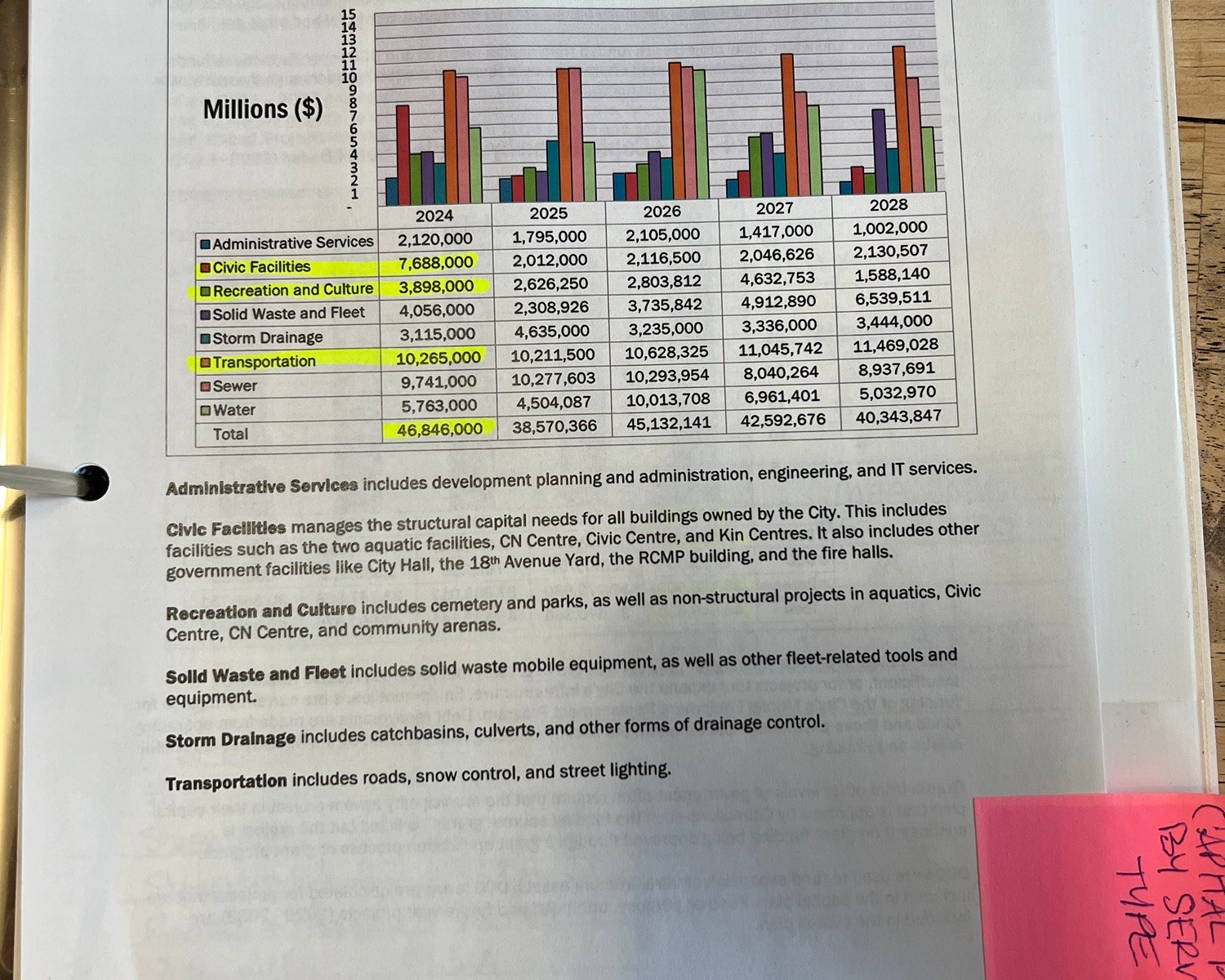
In 2024, we see a capital plan for $46.8M with $15.2M for new/upgrade projects and $31.7M for reinvestment type projects. When looking at the capital plan (which consists of funded projects, unfunded projects, and future years projects), I like to reference the reserve balances because while GIRF does impact the tax levy (remember that 1% we collected above for our infrastructure reinvestment gap?), there are ways we can fund capital projects where it doesn’t impact the levy, like if we get grant funds or gas tax money from the feds/province.
Let’s start off by addressing ‘what is a funding gap’? This is the amount of money we need to collect to replace our current infrastructure. Looking at the next ten years, there are civic facilities that need reinvestment in order to remain operational. For instance, if we look at the PG Playhouse, we can see that in order to keep it functioning, it will likely require $2,142,299 within the next ten years (and if we ask the other question, it’s much more than $2M). Overall, just for the facilities listed below the reinvestment amount is $46M and requires $4.6M per year to get us there. Keep in mind that this is just for 7 facilities and doesn’t include other reinvestment that is also required like for parks, trails, roads, etc. Remember that GIRF levy that was at $2.95M? That’s why we need to fund GIRF at 1% of the levy per year – so that we increase it incrementally rather than all at once to have the funds necessary to reinvest into our infrastructure (Google Osoyoos 39% increase if you want to know how bad it can get).
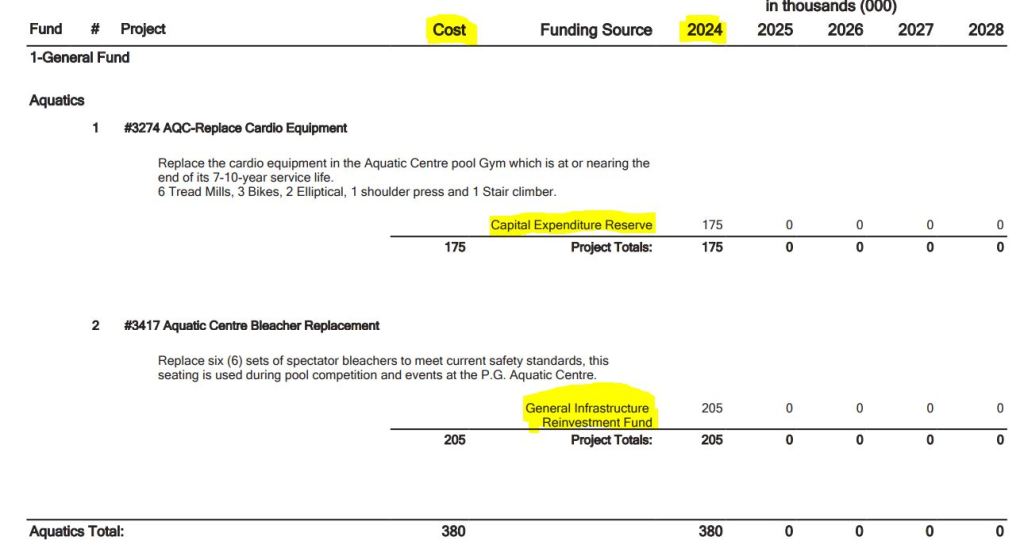
Next, let’s look at the two funded capital projects. The first is project #3274 which would see the cardio equipment at the Aquatic Centre pool gym replaced. We can see that this is funded at $175K in 2024 from the Capital Expenditure Reserve.
This is where referencing reserve balances comes in handy. If we look at the Capital Expenditure Reserve balance (this reserve does not impact the tax levy as it is funded by an annual contribution from our gaming revenue (money we get from the province from the casino) as well as interest we get on our endowment reserve) we can see it has a balance of $2.8M on Dec 31, 2022 and also would have also received the 2023 gaming contribution as well, so the balance is likely somewhere in the ballpark of $5.8M.
Then we ask the question, is it necessary to fund in 2024 – what advantage does this provide? Well, we heard that the equipment is at the end of its life and this is a decent revenue stream for the Aquatic Centre, so funding it would ensure that revenue stream remains in place. You might look at the $175K and think that’s a lot for 6 treadmills, 3 bikes, 1 should press and 1 stair climber. It’s important to note that city staff will look for ways to find savings and if we do save, they will return the unspent savings to the reserve which can be used for future projects.
The second capital project is #3417, the Aquatic Centre bleacher replacement project which sees the replacement of the bleachers at a cost of $205K from GIRF. Now this is a project that does impact the tax levy. Choosing to not fund this project could see the tax levy reduced but we could also choose instead of reducing the tax levy to fund the GIRF reserve to ensure we’re maintaining that 1% for the infrastructure funding gap. We did hear that regardless of funding this project or not, the bleachers are at end of life and need to be removed due to safety issues so funding this project made sense.
Council went through the capital plan project by project asking questions, and getting more information and then we went through the capital project again for approval and decision. At the end, there were projects that were funded, projects that were moved to unfunded, as well as projects from unfunded and future years that were forwarded to Committee of the Whole for more information.
Enhancements
Enhancements are things that are changes from the status quo budget or things that residents or council ask for throughout the year. This year we had a number of enhancements for consideration. Without making changes to the budget and approving the enhancements as is, this would have put us at a 8.23% tax levy. Basically we reduced the levy by 1.45% or $1.87M. Here’s how we did it:
RCMP asked for four new officers at $883,128, this was instead funded for four officers starting July 1 at $441,564 shaving off 0.34% from the 8.23 levy. Next was police support which asked for two municipal staff in the amount of $160,960. Council approved one of the two positions for $77,923 shaving another $83,037 off the levy.
Next was an increase to the fire department which asked for 5 firefighters and 2 support staff. Council approved the $594,220 as well as $76,519. The full enhancement request was for $907,327 so there was a further reduction here. We also saw that by delaying the hiring of the new firefighters, we could fund the Phase 2 Fire Training Feasibility study without increasing the levy which was Councillor Sampson’s idea and passed.
The REAPs request of $100k was not supported and the Exploration Place saw their request partially funded at $25k + $25k rather than the $25k + $75k they requested.
Finally, the roads enhancement of $300k that F&A put forward did not pass. I would have liked to see us try and increase this to decrease the funding gap but I understand why it was unappealing.
The 6.78%
My hopes in writing this blog is to give you a different perspective on the budget process and share my opinion, learnings, and understanding. Budget is a balancing act and I do believe that council did great job finding ways to reduce that initial 8.23% down to 6.78%.
Thanks for reading! If there are any questions, comments, considerations, please don’t hesitate to get in touch.
There was an article published today in the CBC by Kate Patridge and you can view it here regarding the Mayor spending over his allowable expense limit. Yesterday, I was sent the full extent of the FOI package and asked if I wanted to provide comment on its contents. I didn’t feel it was appropriate to comment on another council member’s spending until the item comes before council for consideration (read to the bottom to find out when); however, there are some things I want to comment on to provide additional clarity/perspective.
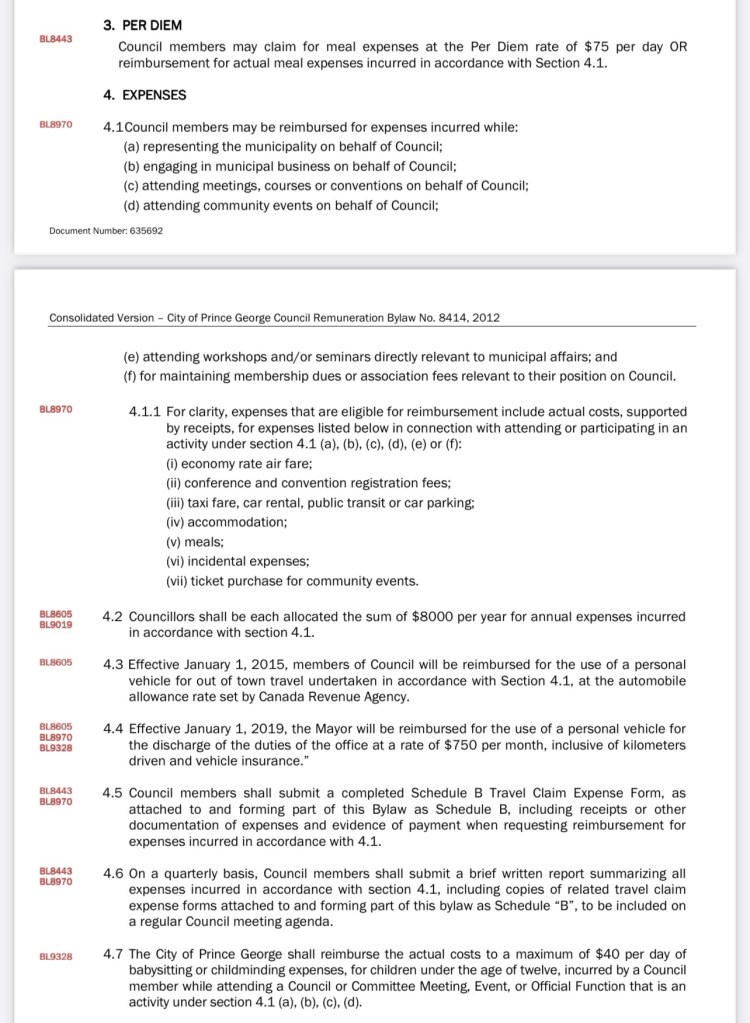
Upon reading this article, one might ask who or what governs council spending – and that is a good question. The what is the council remuneration bylaw which sets out guidelines for council expenses and is very clear on what they can be used for. You can find the excerpt below or read the full bylaw here which was updated and came into effect on January 1, 2023.
That brings us to the who – who is responsible and accountable for our expenses? The answer is simple. We are. It’s not our staff. It’s surely not an executive assistant. It’s definitely not the city’s communications department. While they can support us in providing an update as to where we’re at if asked, the responsibility lies with individual council members – at least in my opinion which has been informed by five years of governance experience and orientation sessions.
All of council receives extensive orientation and training at the beginning of the term and we also receive additional information sessions throughout the year on things like the council remuneration bylaw, the council procedures bylaw, the community charter, the local government act, conflict of interest, and more. And there’s even conferences like the Local Government Leadership Academy (LGLA), NCLGA, and UBCM which add additional educational opportunities to learn about our role and ensure we are performing business in the interest of the public.
Accountability doesn’t stop there. Every year, the Statement of Financial Information (SOFI) report comes before council which lists all of the council expenses, and we as a council get to debate and make recommendations or referrals back to staff based on those findings. So while this article is letting you know of this now, there’s also a mechanism in place for this to be reported to the public once all the year end financials are finalized.
You might also be wondering why council has an expense limit at all and this is a very normal practice for all municipalities – and that expense limit is very prescribed and is meant for attending conferences which is where a lot of advocacy and minister meetings takes place. Some might not find value in this, but I personally find it an incredible opportunity to learn about key issues, to endorse or oppose resolutions, advocate on behalf of my community, and meet and learn from other leaders experiencing similar issues in their communities. This year in particular was also an opportunity for me to run for and get elected as Director at Large for UBCM providing even more opportunity for advocacy.
There are sure to be many questions regarding this article, and council will have the opportunity to raise those questions when the SOFI report comes forward to report on council spending for the 2023 fiscal year in 2024.
I said I’d blog more, so here I am, with another blog, this time on the code of conduct.
There’s been a spattering of interest regarding the vote outcome on the council code of conduct (from here referred to as the code) from the Dec 4, 2023 council meeting at agenda item E.2 here that saw Mayor Yu and Councillor Klassen opposed citing concerns over the code being undemocratic due to the city manager playing a role in the complaint process and asking instead for an ethics commissioner.
Let’s perhaps first start with why we undertook this work in the first place. Our old code was written in 2013 and has not been updated since. It contains no provisions for how to actually bring forth a complaint, nor does it contain how to handle a complaint should one be brought forward. Given that its purpose is to help us navigate a complaint, this is a pretty big issue that needed to be resolved.
So, why is this important? Some might not know, but council members are not employees of the city, therefore, WorkSafeBC and other provincial rules that apply to ‘employees’ do not apply to council. Yes, it’s odd, and many municipalities have filed resolutions with NCLGA and UBCM asking the province to fix this issue. Until it is fixed, having a code is the workaround – which until this term when the province mandated councils consider implementing a code – keyword is considered… was not mandatory.
So that brings us back to our code. On Monday, lawyers from Anderson Young, who drafted our code presented to council, a code for first three readings. Council was able to put motions forward for amendments and a few were adopted making some minor language changes. It’s important to note that UBCM formed a Working Group On Responsible Conduct in 2016 and this group has done important work making resources available to local governments around the formation of codes. You can review more info on that here. Our code, in my opinion, follows the resource laid out by the Working Group and fixes the gap that existed in the previous version. It is in effect an upgrade.
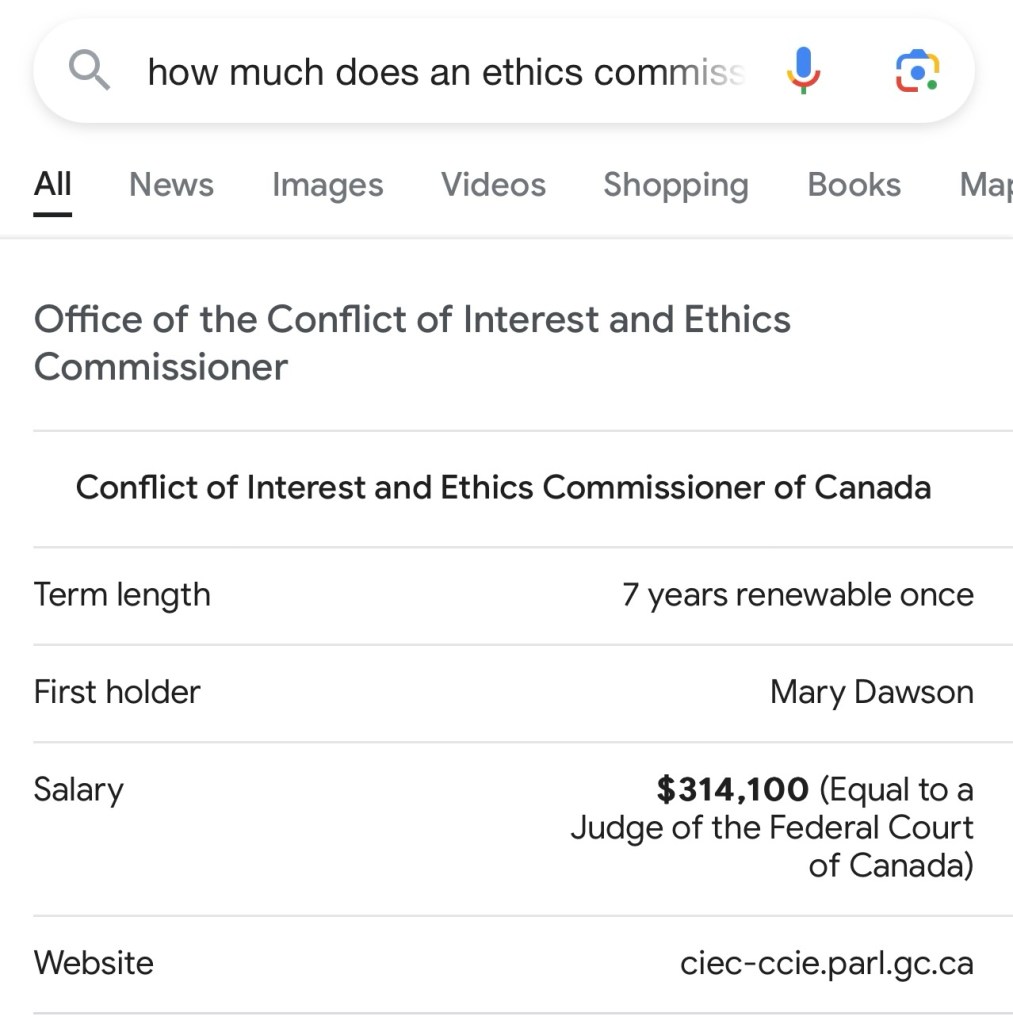
So why was there opposition? Despite the fact that there are very few municipalities with an ethics commissioner, some believe this is more appropriate than utilizing the city manager (whose role is limited and who mostly acts as a facilitator between a complainant and an investigator) for this administrative function. A Google quick search shows that Ethics Commissioners earns the same salary as a Federal Court Judge which is around $314,300. And to hire an ethics commissioner, you need to hire a law firm which means likely a retainer fee meaning it would cost even more.
Here’s the point I made that I thought resolved the issue: White Rock submitted a resolution to UBCM in 2022 asking that the province create an ethics commissioner office for municipalities – a resolution that was endorsed meaning this office could become available to municipalities in the future without us having to fund the position.
Not all were swayed by this argument however, and the two that disagreed cited the code as being undemocratic due to the perceptive nature of requiring the city manager to delve into a council conflict. It should be noted that the code of conduct is not just for council but it is also for employees who could lodge a complaint against a council member – and by chain of command standards, taking said complaint to our highest ranking emoloyee is appropriate.
So that the gist of the code of conflict debate. What do you think of codes in general or of ours specifically (it’s linked in the report above and attached in the bylaw)? What choice would you have made regarding an ethics commissioner? And do you think a code of conduct is undemocratic?
It has been a long while since I have written a blog. And I love blogging, like a lot. But in today’s polarizing world, being vulnerable especially about complex problems with varied opinions, is not as easy as it used to be. The backlash seems harsher and yeah, my skin is occasionally thick but most of the time it’s not. So, please be gentle with me as I attempt to blog more.
Last week I attended my first UBCM board meeting of the 2023-2024 term in Vancouver. The UBCM board is an incredible group of elected officials coming together, doing important advocacy for local governments across the province. We have an amazing group elected to the board including our awesome President Trish Mandewo, Councillor for the City of Coquitlam. You can learn more about UBCM on their website here.
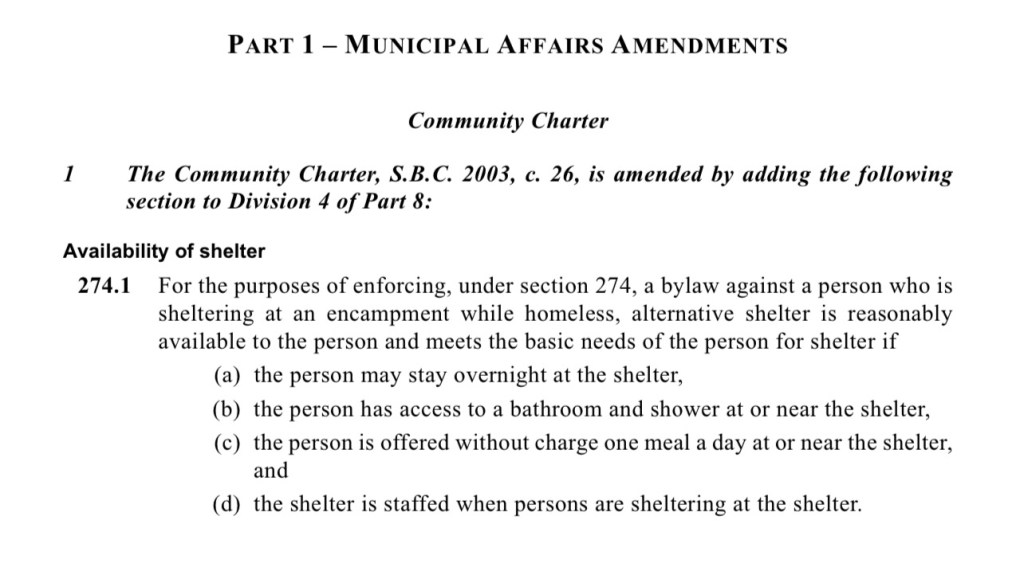
An important topic of conversation was Bill 45 called the Miscellaneous Statutes Amendment Act (No. 4), 2023. This bill makes an amendment to the Community Charter and the Vancouver Charter and basically says that in order to enforce a bylaw against a person who is sheltering in an encampment, local governments will have to ensure alternative shelter is reasonably available.
There are a few problematic issues with this legislation, the main one being that it is being put through some miscellaneous statutes act without local government consultation. And local governments have questions, like what does this mean for how we govern our communities?
There are so many unanswered questions and without doing proper consultation, it is the opinion of many that this piece of legislation does a disservice to everyone in our community. Here’s how President Trish Mandewo put it in her op-ed in today’s edition of the Vancouver Sun:
“This is a lose-lose-lose scenario — for homeless people who need appropriate housing, for residents who are concerned with the fate of so many individuals who have no other choice than to camp, and for local governments which have the responsibility for maintaining parks and public spaces for the use of the community. It does not have to be this way.”
There are many reasons why this legislation needs to be withdrawn and for local government consultation to occur. You can read more about Bill 45 in the full op-ed here.
In addition to Bill 45, there are many important issues facing local governments every day and a lot of that work seems to be incredibly invisible. Know that many of your council members are working hard behind the scenes to find answers to complex questions and a lot of this takes time. And while that time passes, I recognize that residents are becoming increasingly frustrated, and fairly so – you have every right to be frustrated because admittedly, the answers aren’t coming soon enough. And there might not be anything I can say that will lessen that frustration – but know that I continue to work hard on these issues with several of my colleagues locally and across the province. I will continue to answer your questions the best I can, learn, grow and govern in a way that moves us closer and closer to a win-win-win resolution.
Should you have any questions that need answering, or want to provide comments, please feel free to contact me.
I was at the dog park this week speaking with a young 29 year old elector who told me he had absolutely no interest in voting. We chatted for a bit about the importance of getting out to vote but I couldn’t persuade him to participate because to him, one vote wouldn’t make a difference. It got me to thinking – how many local government elections are shaped by one vote – one elector?
I heard a story ages ago from the Mayor of the Northern Rockies Regional Municipality Mayor Gary Foster about his election to council in the 90s where he tied with the last place candidate. Both candidates went before a judge to make a determination and that judge drew names from a hat, and declared him the winner of the election. According to The Candidate’s Guide for Local Government Elections in BC, this is still a current practice and there are two ways to deal with a tie: drawing names from a hat, or doing a runoff ballot.
So going back to the question: does your vote really matter – can one vote really make a difference? I reviewed all the voting data from every local government election in 2018 and found some interesting examples that prove one vote really does make a difference.
Anmore, Burns Lake, Highlands, Keremeos, Lion’s Bay, Lytton, McBride, Midway, New Hazelton, North Saanich, Radium Hot Springs, Silverton, Telkwa, Trail, and Zeballos had councils where every candidate was acclaimed. One could argue that a single person putting forward their nominations papers could have produced an entirely different outcome in the election.
In Belcarra, the last place elected councillor won by just one vote, and in Armstrong, Cumberland, Gold River, Greenwood, Pouce Coupe, Powell River, Sparwood, and Squamish, the last place elected councillor won by just two votes. Those communities where the last place elected councillor won by less than 10 votes: Qualicum, Slocan, Hazelton, Merritt, Sicamous, Creston, Port Alice, Sayward, Logan Lake, Coquitlam, New Denver, and Barriere.
Here’s the full list ending with Nanaimo, which had the biggest spread between the last place elected councillor with a 2564 vote spread.
It might not seem like your vote makes a difference but it can and it does. So, this election, we have two more days of advanced voting opportunities and general voting day for you to get out and cast your vote. It very well could be the difference between your candidate getting elected or not.










 coriramsay