Let’s Talk about Short Term Rentals

There have been many questions this week about the decision to opt-out of the short term rental legislation by council and I’m going to do my best to share my thoughts on the matter. Before we delve in, let me clear the air – the question has been asked about whether or not I own or have any partial ownership or financial stake in short-term rental properties which might have influenced my decision. So for the record, no, I do not own or have a financial stake in any short term rentals (STRs).

Why are we considering opting out of the STR legislation?

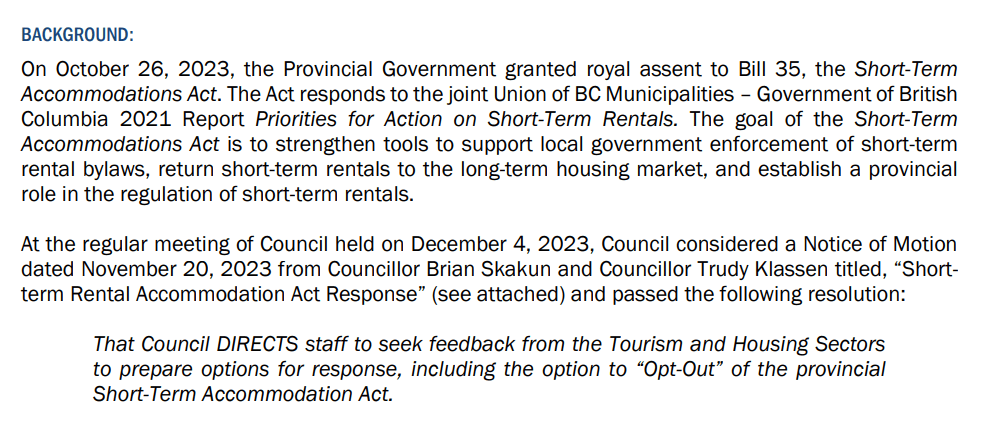
In December, Councillors Skakun and Klassen brought forward a notice of motion for council to consider opting out of Bill 35, the Short Term Rentals Accommodations Act. Staff prepared a report which you can read here at item D.11 and after much debate council directed staff to ask the province to opt-out of the STR legislation. Below I will highlight some of the factors that influenced my decision.
Vacancy Rates

In the staff report, it states that Prince George currently has a vacancy rate of 2.8% and we are ineligible from opting out. I questioned this data for a couple reasons, the main one being that I am very familiar with the CMHC Market Information Portal and understand its limitations as I use it for work as a Marketing Analyst and have used the data in this portal since 2015 to calculate the living wage for Prince George.

One of those limitations is that the CMHC Housing Survey only includes data from privately initiated structures with at least 3 rental units, which have been on the market for at least 3 months. Now, this automatically excludes single-family detached houses (17,995), movable dwellings (2,170), semi-detached houses (1,285), and apartment or flats in a duplex (2,305).
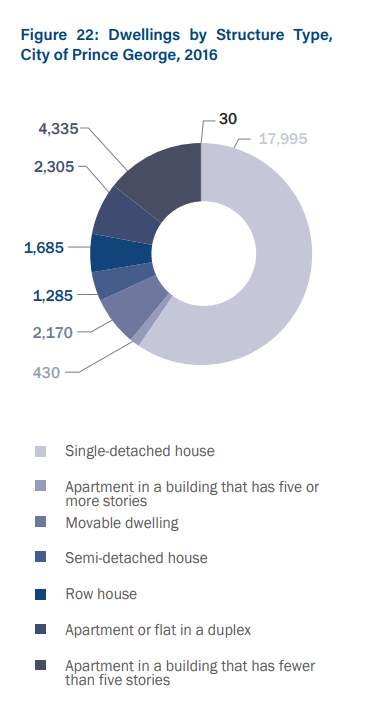
Essentially, right off the get-go, CMHC excludes a significant number of properties – 23,755 to be exact – from the Housing Survey which looks at things like market rents and vacancy rates. This is important because from our own Housing Needs Assessment, we can see that only 46% of renters are living in apartments meaning that 54% are living in dwellings CMHC does not consider in its survey data.

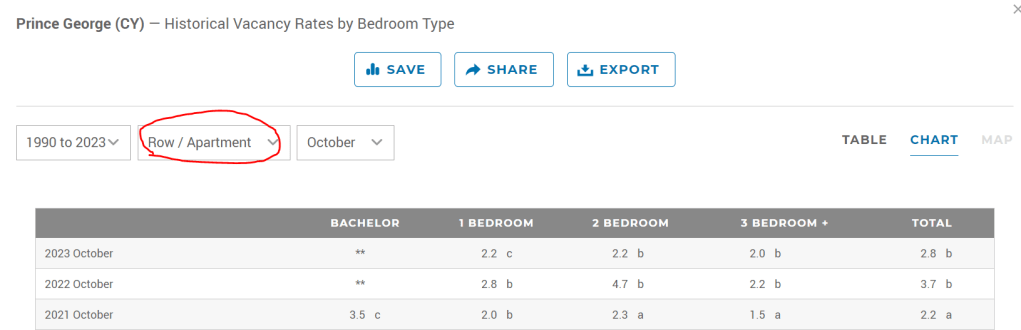
Now, let’s look further into the vacancy data. When we look at the vacancy rate for row/apartment, we can see it says the rate is 2.8 and has fallen from 3.7 in 2022. I automatically ask why the vacancy rate fell over 1% from the previous year.
Row housing is defined as “any building containing 3 or more rental units, all of which are ground oriented, side-by-side, with common walls dividing each rental unit. Owner-occupied units are not included in the rental building unit count. These row units in some centres are commonly referred to as townhouses.”

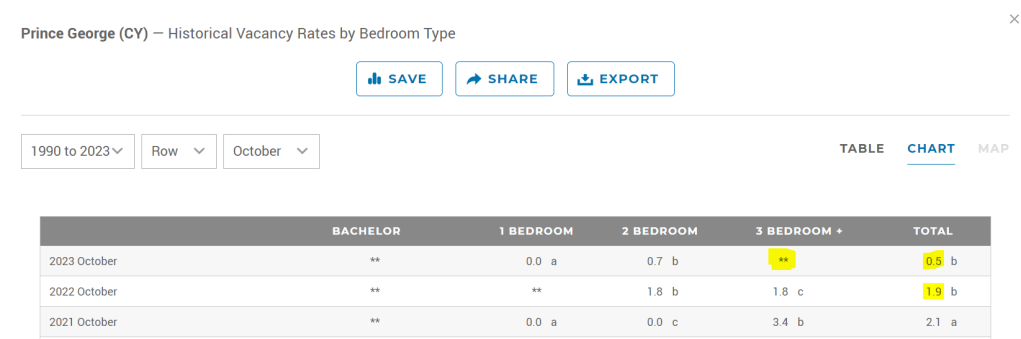
When we look at row housing, we can see that the 3 bedroom + category contained a vacancy rate of 1.8 in the following year and instead has ** listed for 2023 which is overall bringing down the row house vacancy rate from 1.9 to 0.5. The reasoning from CMHC is that the data is suppressed to protect confidentiality or the data is not statistically reliable. Given that it was listed in the previous year, I believe there to be a strong likelihood that the data is not reliable rather than being omitted due to confidentiality. We can also see from the Housing Needs Assessment that only 9% of renters are living in row housing.

To me, it is reasonable to exclude the row house vacancy rate due to the low number of renters living in this housing type as well as the 3 bedroom rate being omitted from the data.
What this leaves us with the the apartment vacancy rate of 3.0 which means if the row housing is omitted, council does have the authority to make the decision on whether or not we can opt-out this year of the STR legislation.

Affordability

There are a significant number of factors that impact home ownership affordability. Housing stock availability certainly plays a part but there are other factors that come to mind:

  • Your Total Debt Servicing (TDS) ratio. TDS is your total debt obligations divided by your total income in the form of a per cent and the industry standard cutoff is 42%. If you have any other debts – a car loan, student loan, debt consolidation loan, etc. – this is going to impact your TDS and if it’s over 42% you will not get approved by a lender.
  • The Stress Test. The stress test was implemented in 2018 and applies to anyone purchasing a home with less than a 20% down payment. The stress test ensures that you can still make mortgage payments should rates change. Basically, you have to get approved at either the minimum qualifying mortgage rate of 5.25 per cent, or their contract rate plus two percentage points, whichever is higher.
  • Rates. The Bank of Canada has increased rates to slow inflation, this is resulting in higher interest rates sitting currently around 5%. With the stress test, this means that individuals need to get approved at around 7%.
  • Amortization period. If you have less than a 20% down payment, the maximum amortization period for an insured mortgage is 25 years. In the market, 40 year mortgages are available to those with more than 20% down payment; however, those with lesser down payments are required to pay their homes off almost twice as fast as those who have a greater then 20% down payment. This is meant to regulate $1M+ mortgages and I have questioned why there isn’t a threshold in place for insured mortgages under $1M. The answer is that if policies were to change individuals would be taking on more debt and interest in the long term. My response was shouldn’t that be an individuals choice?

Does more housing stock equal affordability?

I was recently at the UBCM Housing Summit and a panelist said: “It’s just basic economics, the more stock we add, the more affordable housing will become.” There are so many other factors contributing to affordability that I have to ask the question if this is actually true?

The Province seems to think so and in fact, they hired Jens von Bergmann of MountainMath Software & Analytics in addition to UBC Sauder and Sociology staff as well as a professional from Terra Housing, to provide an analysis on how adding density will achieve affordability. One line that stood out to me was this: “The additional 44,000 to 54,000 net growth in dwellings over 5 years estimated by our model would result in 6% to 12% lower prices and rents than what they would have been without the provincial legislation.”

The issue I have with this is that the opposite of ‘adding density betters affordability’ is currently happening in Victoria. They have implemented zoning that allows fourplexes on single family lots and up to twelve-plexes on corner lots. They’ve added a great deal of density and since the new zoning implementation, their vacancy rates dropped 0.01 while their rents increased by over $200 per unit since the previous reporting period.

Why should we keep Short Term Rentals?

Based on the information from PG Realtors, there are 259 active Airbnb’s in Prince George. Searching actively on Airbnb and removing principle residences, about another hundred residents are excluded meaning overall, we are looking at roughly 150 STR properties likely being impacted. 150 of 31,793 dwellings according to the most recent Statistics Canada Census data. This is 0.4% of our total dwelling count. Long term rentals are still an attractive investment option and eliminating the 0.4 STRs in our community converting them to long term rentals is not going to influence the market enough to change market rental rates and immediately make things more affordable.

Health Considerations

In 2021, I chaired a panel at NCLGA with Cathy Ulrich, then CEO of Northern Health. Housing availability was among the most challenging barrier to recruitment for health professionals. According to a CTV article, “in 2022 [Northern Health] has spent $37.7 million on [externally contracted] agency nurses, technicians and other allied healthcare workers. The five-year total is at least $105 million. Every other health authority combined spent at least $102 million in that time on private staffing to keep public health-care facilities running.”

We know that Northern Health is spending more than all the other health authorities combined in order to provide basic care and the reality is that many of these health professionals do utilize short-term rentals. We also have a number of individuals from outside of Prince George who come here to give birth, receive cancer treatment, utilize hospice services to name a few services because not all of these critical health services are available in all communities. Short term rentals emerged in the market because they met a demand – a demand that still exists today and eliminating them will have consequences on rural, remote, and northern communities.

Tourism Revenue

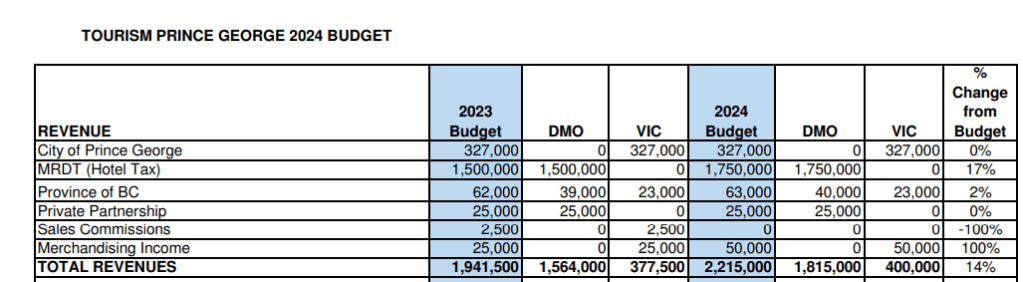
I’ve seen some comments that STRs do not contribute to Tourism Prince George through the MRDT hotel tax and I want to comment that council has asked Tourism PG this question. CEO Colin Carson has confirmed that STRs do contribute to the MRDT and infact in their 2024 budget we do see their revenue increasing by $250,000. So not only are these properties contributing by paying property taxes, they are also contributing to marketing initiatives and supporting a great non-profit.
Conclusion

You might not agree with my decision to support the opt-out of the Short Term Rental Legislation and that is okay. Disagreement is part of a healthy democratic society. Whether or not you agree, I hope that at least you can better understand my reasoning for coming to this decision. Regardless of where you stand, know that this decision still needs to be approved by the Province. They might not agree with the logic of excluding row housing which puts us back to a 2.8% vacancy rate. They might agree with us and approve the opt-out, in which case we will have to have this debate annually as long as we have a representative vacancy rate above 3%. And if the vacancy rate does fall below 3%, it will be 2 years before council can reconsider.

Do you have questions or comments about STRs or perhaps there’s additional information you think I should consider. Send it my way. Thanks for reading!

So you want to learn about our housing market?

Over the last six years I have calculated the Living Wage for Prince George in addition to other communities in Northern BC and I’ve learned a great deal about various aspects of the calculation, housing being one of those things. When the city launched their housing needs assessment survey this week I couldn’t be more thrilled. Here’s why…

The data is only as good as the info collected

Canada Mortgage Housing Corporation (CMHC) is a crown corporation governed by Parliament. They are Canada’s national housing agency and a lot of our national housing data comes from their research. There are a couple things I find concerning with their methodology, the biggest one being accuracy.

Taking one look at our market housing data it doesn’t take a rocket scientist to realize that there is no way a 3 bedroom rental in Prince George costs $950 a month. In fact, you’d be hard pressed to find a one bedroom for that amount. (Note: $950 represents the median rent for a 3+ bedroom in Prince George; the median is used instead of average in the living wage calculation so that luxury rentals don’t skew the data).

According to CMHC, “the survey is conducted on a sample basis in all urban areas with populations of 10,000 or more, and targets only privately initiated structures with at least three rental units, which have been on the market for at least three months.” Here are the issues I have with the methodology:

  1. “Sample” data never gives you a full picture because it only represents a subset of the thing you’re looking at. Yes, it does allow you to make inferences but this with the other issues below muddies the waters too much for my liking.
  2. The sample data, as far as I can see, doesn’t seem to be defined (at least it’s not listed in the CMHC methodology glossary so not having this readily available makes me question the transparency of the data). Is it a 25%, 50%, or 75% sample set of the market rental housing data?
  3. Only 31 of the 107 communities in British Columbia have populations over 10,000 which means that this data is only representative of 28% of communities in BC so there’s a lot of housing data being excluded.
  4. “Privately initiated structures with at least three rental units” means that the survey is missing out on a lot of rental units, especially in communities that allow secondary suites. It also means that smaller communities who are less likely to have more multifamily housing don’t actually get an accurate read on their housing market.

Independent Research: A Housing Needs Assessment

We know the CMHC Market Rental Housing data isn’t really representative of communities, so how do we fix this? The answer is the Housing Needs Assessment. Communities are now mandated to do a housing needs assessment every five years and this year, the City of Prince George is undertaking this assessment.

So how you can help? Do the survey by September 30th. By collecting data from residents, we can get a more comprehensive snapshot of what our housing market looks like without relying solely on CMHC data samples. Of course, the less people who do the survey, the smaller our own survey sample will be so encourage your neighbours, friends, and family who live in Prince George to do the survey because we want our sample to be as comprehensive as possible.

What can we do with the data once we have it?

According to the Cities Economic Development Manager Melissa Barcellos, “Housing needs reports provide a snapshot of the current community demographics, the housing supply, and anticipated future housing needs. They are a tool for local governments to plan for future housing development.” I couldn’t agree more with this statement. I also think there are a couple other benefits.

Once we have a comprehensive overview of our market housing data, we can advocate better for the type of housing we need in our community. We know there’s a shortage of supportive, affordable, senior, student, and diversified housing stock, but knowing it because we live here and being able to prove it are two different things. Survey’s confirm or disprove hypotheses and I’m certain this survey will prove what we know and help us with our housing advocacy moving forward.

How the data relates to the living wage

When data is collected for the Living Wage, calculators like myself are highly aware that the final living wage figure really is the lowest amount a person can earn without going into debt to just live in their community. It is a bare bones calculation and relying on CMHC for housing data greatly impacts that final living wage figure. Data collected from the housing needs assessment can be used in the Living Wage calculation as an alternative data source (communities that have already completed their assessments are already using this data in living wage calculations) and since the city is required to do a housing needs assessment every five years, we can add the CPI inflationary increases to the housing needs assessment data until the new survey is complete for a more accurate representations of our housing costs.

The why behind the ask

I’m a firm believer of informed decision making and our data – a lot of what we base our decisions off of – is only as good as the information we have. I wrote this blog to help give a more comprehensive overview of the why behind this ask in hopes that more residents will understand the importance of the housing needs assessment and take action by filling out the survey. If you’re not from Prince George, be sure to reach out to your own community and ask them about your housing needs assessment.

If I’ve missed something you think should be included or if you ever want to have a conversation about housing, market research, or even nerd out over census data, please reach out to me. My contact details can be found on the Contact section of my website.

All my best,

Cori

In opposition of nuisance bylaws

I like to think of myself as a strategic problem solver and a critical thinker. I read my council agenda packages front to back and do independent research trying to absorb as much as possible in preparation for every meeting to be sure I am making informed decisions on whatever matter comes before me. The City of Prince George Safe Streets Bylaw came before council several times and I’ve been opposed because I’ve read about these bylaws in other communities and they are proven to not work.

So let’s start with what exactly is a Safe Streets Bylaw? It is in effect a nuisance bylaw that prohibits people from sitting, lying, soliciting or physically approaching in a manner that causes an obstruction on a street or roadway. It prohibits soliciting within ten meters of a bank, ATM, bus stop, daycare centre, liquor store, cannabis retailer, restaurant, coffee shop, or convenience store. The bylaw goes on to include solicitation prohibitions for parked vehicles, vehicles at traffic control signals, gas stations, and vehicles on the road.

The solicitation that is allowed under this bylaw is restricted and not allowed after sunset on any given day. The bylaw further disallows open drug use, disposal of drug paraphernalia in a public place, open air burning in a public place, and graffiti where it is visible from a public place. This bylaw attempts to change what Bylaw Services deems to be unacceptable behaviour and fines individuals for non-compliance.

The City of Prince George is not the first community to pass a nuisance bylaw, in fact many other communities have passed some form of nuisance bylaw. Some outright call it a nuisance bylaw, some call it a panhandling bylaw, some even call it a good neighbour bylaw. Here are some examples: Salmon Arm, Campbell River, Maple Ridge, Kamloops, Kelowna, Duncan, New Westminster, Calgary, Mission, Oshwa, Red Deer, Victoria, Enderby, Saskatoon, Swift Current.

This bylaw seems to be saying ‘homeless people should be unseen and unheard.’ Ignoring a problem doesn’t make it go away – this is Life 101 – so why is this situation any different? The bylaw is not fair or equitable. It relies on judgement from Bylaw officers and they’re not going to ticket your granny for sitting in front of a coffee shop, so how is it fair that someone who looks different should get a ticket?

This bylaw is intended to change undesirable behaviour. Think about the last time you got a ticket, a fine, a late fee – was your immediate response, hmmm better shape up? I’ve gotten speeding tickets, parking tickets, late fees and every single time my first response was anger and frustration – even if I was in the wrong. I am convinced that this bylaw is going to have the opposite intended affect: we are going to see more destructive behaviour; it’s going to increase crime, vandalism, and the lawlessness that’s occurring. It’s also going to break any trust we have built up making it harder in the long run to make progress on this issue. It’s a band-aid and band-aids don’t actually solve the problem.

We know what we need to make change happen in our community. We need a treatement center for women and youth. We need a sobering center. We need low and no barrier housing and more variety/stock. We need partners like Northern Health, the Province, the Federal Government, RCMP, to come to the table. We need consultation with people with lived experience, Indigenous, BIPOC, LGBTQ+ groups and others to understand the root of the issue better. We need a place for people to go during the day. The pandemic has reduced the number of people being served indoors by our social service agencies; if agencies occupancy numbers don’t increase, the only place for homeless individuals to hang out during the day is on the street.

If we had all the things we needed, perhaps I would consider this type of bylaw. But I believe there are other avenues that we need to exhaust first before implementing a nuisance bylaw.

I tried really hard to stop this bylaw from going through. I moved postponement on the bylaw when we looked at it in June, knowing that should the encampments get dissolved without housing options in place, people would move back to sleeping in doorways, on sidewalks, in parks, and these individuals would be disproportionately affected by the bylaw. I called for a change to the definition of the word Emergency in the Emergency Programs Act. This would give us funds to provide accommodation and food to our homeless population similar to how we can when taking in evacuees from wildfires and other natural disasters. I moved that we ask BC Housing to include ‘No Barrier Housing’ options in their housing strategy. Interesting fact: the word no barrier does not exist on the BC Housing site – not even in their glossary. We need to meet people where they’re at and stop requiring them to meet our list of demands or ticky box barriers in order to receive help.

My commitment to you is that I will continue to work hard for a safe, clean, and inclusive community but the city can’t do this alone. As a city, our mandate really comes down to land use and governance – health care and housing don’t really fall under our jurisdiction but we can advocate for these things. In order to do this though, we need your help. Here’s how you can make a difference:

  1. Write letters to your MLA, your MP, the Minister of Housing, Minister of Social Development and Poverty Reduction, Minister of Mental Health and Addiction, and the Premier.
  2. Support rezonings for supportive housing and treatment centers and try to dispel any ‘not in my backyard’ sentiments – it has to go somewhere and if everyone continuously say no to this important social infrastructure being in their neighbourhood, we will never make progress this issue.
  3. Get out and vote for the change you want to see.
  4. Anytime any level of government asks for feedback, be sure to provide comment and encourage others to do the same.
  5. And finally, if you’re invited to some sort of consultation, look around the room and ask yourself this: is everyone who should be here present? If not, big red flag.

I believe that we can solve this complex and challenging issue but we need to do it together. If you have more ideas on how to make a difference in our community, be sure to check out my Contact page and get in touch. I look forward to hearing from you.

Thanks for your continued support,

Cori