

You might have heard some tea about the AAP (also known as the Alternative Approval Process). Essentially, the City needs approval to borrow funds for a capital project which would allow for preventative maintenance for the PG Aquatic Centre. This maintenance will help extend the life of the pool. In this blog I’m going to provide an overview of the project, our financial position (and why we’re borrowing money), as well as why I supported the Alternative Approval Process (AAP).
The Project
In 2016, the Prince George Aquatic Needs Assessment Report was completed. It found that the PG Aquatic Centre has been well maintained over its life by staff, however, at the time there were several items not to code and there was also an issue with the building envelope. Here’s what the report had to say: “Constructed in 1998, the Prince George Aquatic Centre is structurally, mechanically, and electrically sound. A pool audit report of the facility was recently completed by Councilman-Hunsaker and can be found in Section 11.2.4. Overall, the Aquatic Centre is in good condition. It is obvious that a well trained staff has taken care of the pools and their associated mechanical systems. There are certain items that are not code compliant. These items should be addressed immediately for safety concerns” (p. 11).
The report goes on to say that the PG Aquatic Centre is “performing as required, but has the following drawbacks: The mechanical system is not performing well and should be revamped [and] There is significant building envelope issues at the roof-top parapets that must be dealt with in the immediate future.”
In 2019 (aka the immediate future), Council approved the building envelope and mechanical project with a (class C estimate) budget of $8.58M, and in 2020, the city was successful in a grant application for $6.3M from the Investing In Canada Infrastructure Program’s Green Infrastructure Stream (note that when you apply for grants like these, you cannot start work prior to the grant being awarded otherwise it becomes ineligible). This increases the project budget to $14.88M and allows for – in addition to just the envelope and mechanical works – some insulation and air tightness work to better the buildings greenhouse gas emissions. Construction was supposed to start in 2021, but we put some projects put on hold during Covid and we also hosted the BC Summer Games which further delayed this project.
This brings us to April 4th, 2024 when council received a tour of the facility to highlight additional concerns that were found when the Project team reviewed the scope of work, all of which are listed in the April 22 Council Report. We also have the high level energy analysis from a Professional Engineer which articulates how upgrading some materials would result in energy efficiency savings and also help increase the life of the asset. It’s kind of like replacing the windows in your house with high efficiency windows – that and additional improvements (metal cladding over EFIS) will extend the life of the Aquatic Centre by roughly 20 years as indicated in the Engineers Analysis.
So what exactly are the upgrades being completed?
- Phase 1 – Replacement of the building envelope, glazing, roof system, exterior doors, entry columns, leisure pool tiles, acoustic baffles and DDC (Controls) system. Addition of a dehumidification system and new electrical transformer with electrical system upgrades.
- Phase 2 – Repairs to the structural steel/columns and dive tank sparger system. Replacement of main entry soffits, curtain wall and air handling units cooling coils. Addition of energy recovery on air handling units.
- Phase 3 – Replacement of health/life safety items including deck, lobby and visitor area tile, handrails, plumbing fixtures, fire alarm system and sprinkler heads.
- Phase 4 – Replacement of moveable bulkheads, change room tiles, overhead and underwater light fixtures and emergency system lighting, in addition to interior repainting, hydronic piping reconfiguration, increased access controls, accessibility improvements, and reconfigured reception desk.
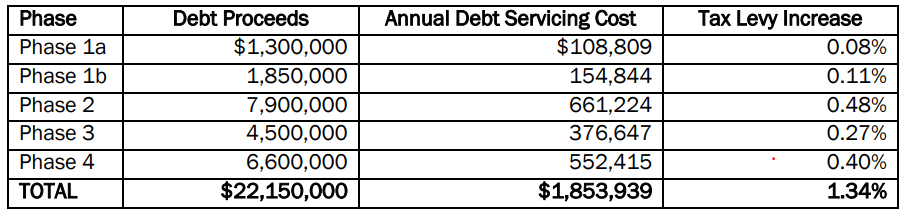
At the April 22 meeting, Council voted in support of the $22.15M for additional works for the Aquatic Centre Envelope and Mechanical project which are listed above and a photo below also shows how much each phase costs. Here’s the voting summary in case you were wondering how each of my colleagues voted:
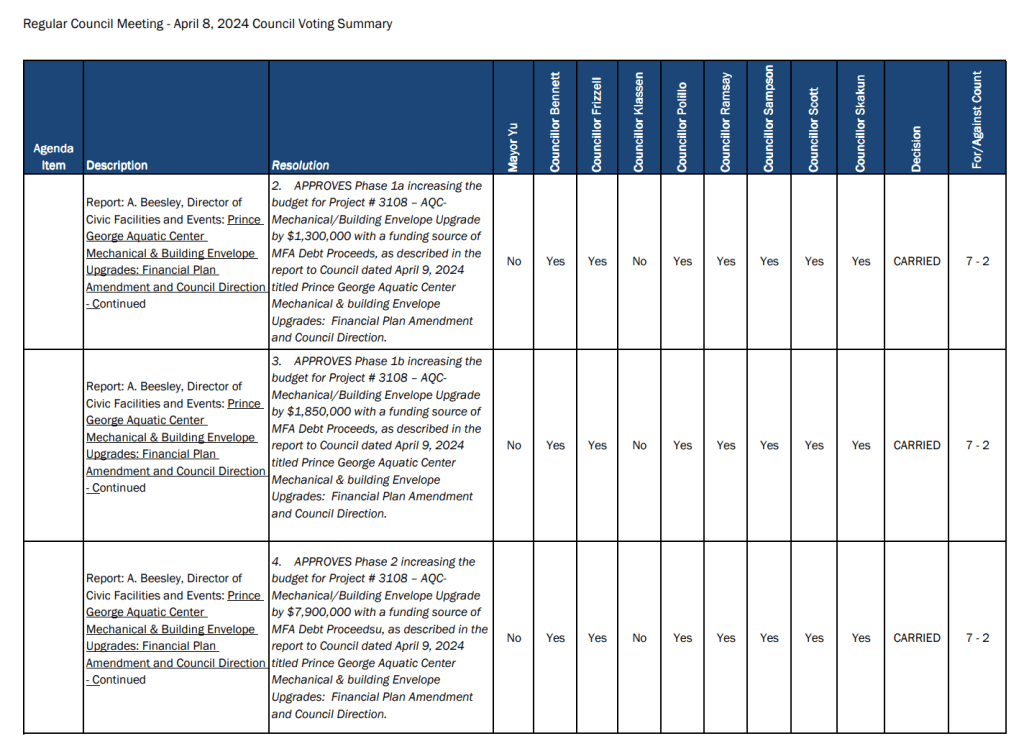

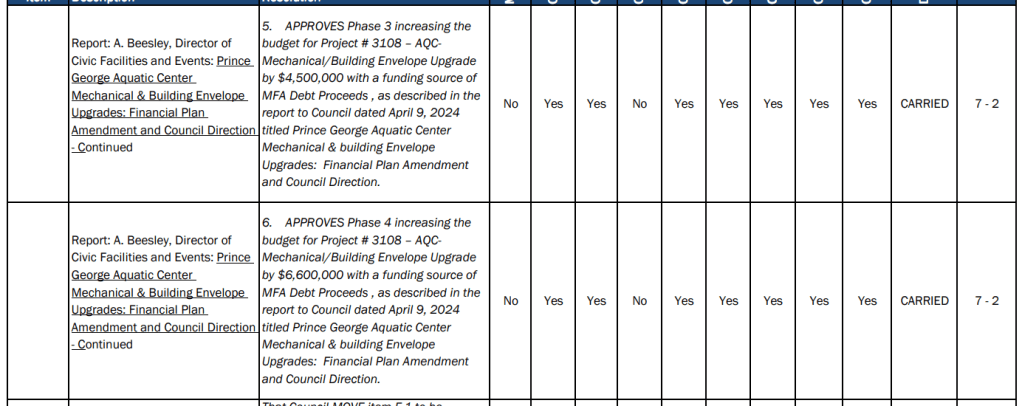
This brings us to the May 6th Report where council decided on the process in which we would seek elector assent. More on that below.
Financial Position
Before we get into the elector assent process, I want to highlight a change that we have made in our sustainable finance policy. In 2023, council approved changes to the finance policy and added in clause 1.3 which states: “To address infrastructure reinvestment needs, an increase of 1% to the tax levy per year shall be added at the conclusion of all other budget deliberations and transferred to infrastructure reserves.”
What this means is that once council has gone through the budget and made cuts or approved enhancements and lands on a tax levy, an additional 1% will be added for future infrastructure reinvestment needs. This equates to a little over $1M per year being collected to assist with our reinvestment funding gap.
Additional considerations: the debt for this project would not come on the books until the project is complete which could be 1-3 budget cycles from now, meaning under the new policy, we could have set aside roughly 3% between now and then. Overall, the total impact to the tax levy to cover the entire debt would require an increase of 1.24%, 1% of which we have technically already collected.
Finally, if you review our Consolidated Financial Statements you can see in Schedule 5 – Debt – General Capital Fund Debt, you can see that we have a number of debts coming off the books in 2025. This reduction in debt obligations could also offset the incoming debt obligation for the Aquatic Centre Building Envelope and Mechanical project. All of this really to say that if we receive elector assent and this is supported, and we do borrow, the impact of this specific project could be minimal to tax payers.

Borrowing Rates versus Deposit Rates
So, why do we borrow at all? This is a valid question that we get from time to time. In our own households, the rates we pay on debt is typically higher than what we earn on deposits so it makes sense to question if borrowing is financial the best option. In the world of municipal finance, municipalities are required by legislation to borrow funds (excludes investments) from the Municipal Finance Authority (MFA). Essentially, when the City of Prince George borrow funds, it gets pooled with other municipal loans in our Regional District and then with those in the province from other Regional Districts/Municipalities and because of the pooled amount being borrowed, the borrowing rates are very favorable.
For example, last month the Hospital Regional District Board received a report which showed MFA borrowing rates to be sitting around 4.18% for a five year borrowing term. Current market rates for deposits are around 4.5% (and higher if you have larger pools of funds) meaning that our Reserves are currently earning more in interest than what we would pay to borrow. This is very backwards from how household debt works.

Another consideration is that when it comes to debt, the individuals paying for the debt are typically the users of the asset. Think of the Canfor Leisure Pool – we could have saved $36M over a period of 20 years and then built the new pool but it would have resulted in users paying for something they might never get to use. Debt has a purpose in municipal finance and it can be used in an effective way to the benefit of the tax payer – and in my opinion, that’s what we’ve done here.
The AAP
First, let’s overview the two processes available to us for gaining elector assent. The May 8th Council Report details the process well, but here’s a quick overview. Option 1 is to run a Referendum in which we appoint a Chief Election Officer and set up voting stations and are required to have advanced polls and have people working those polls, and we also have a mail-in ballot. In this case, the majority of the votes cast determines the outcome. It is very similar to an election; however, voters answer a ‘yes OR no’ question on a ballot voicing their support or denial for the borrowing request. This process cost $91,000 in 2017 and would likely cost more in today’s dollars.
Option 2 for gaining elector assent is the Alternative Approval Process (AAP). In this process, electors would only vote ‘no’ by submitting a form to City Hall. The cost to run this is minimal as electors would fill out a form either at home or request one at City Hall and submit it to City Hall between July 5 – August 9, 2024. If the number of forms the City receives is more than 10% (5,512) of the total number of electors in the city (55,126) as determined by Elections BC, the vote would fail. At this point, council could consider denial of the project, or wait six months (as required by Community Charter) and choose to go to a referendum or try the AAP again.
Conclusion
This project has been in the works since 2016 and a great deal of work has been done. Overall, the Aquatic Centre has been well maintained by staff but it is now 25+ years old and in order to extend its life, we need to do some preventative maintenance. Remember that EFIS that was falling off the PG Playhouse? It’s the same material they used to build the Aquatic Centre. The option to fund this work is to borrow and the market is in our favor, we’ve got debt coming off the books in 2025, and under the new sustainable finance policy we’ve been putting funds aside for infrastructure reinvestment. Should this be approved through the alternative approval process (AAP) it saves us $100K.
Thanks for reading all the way to the end if you made it through – if you have questions, please let me know.
 coriramsay