Bill M216 Submission Deadline Extended

When we use our collective voices and come together in advocacy, we get results.

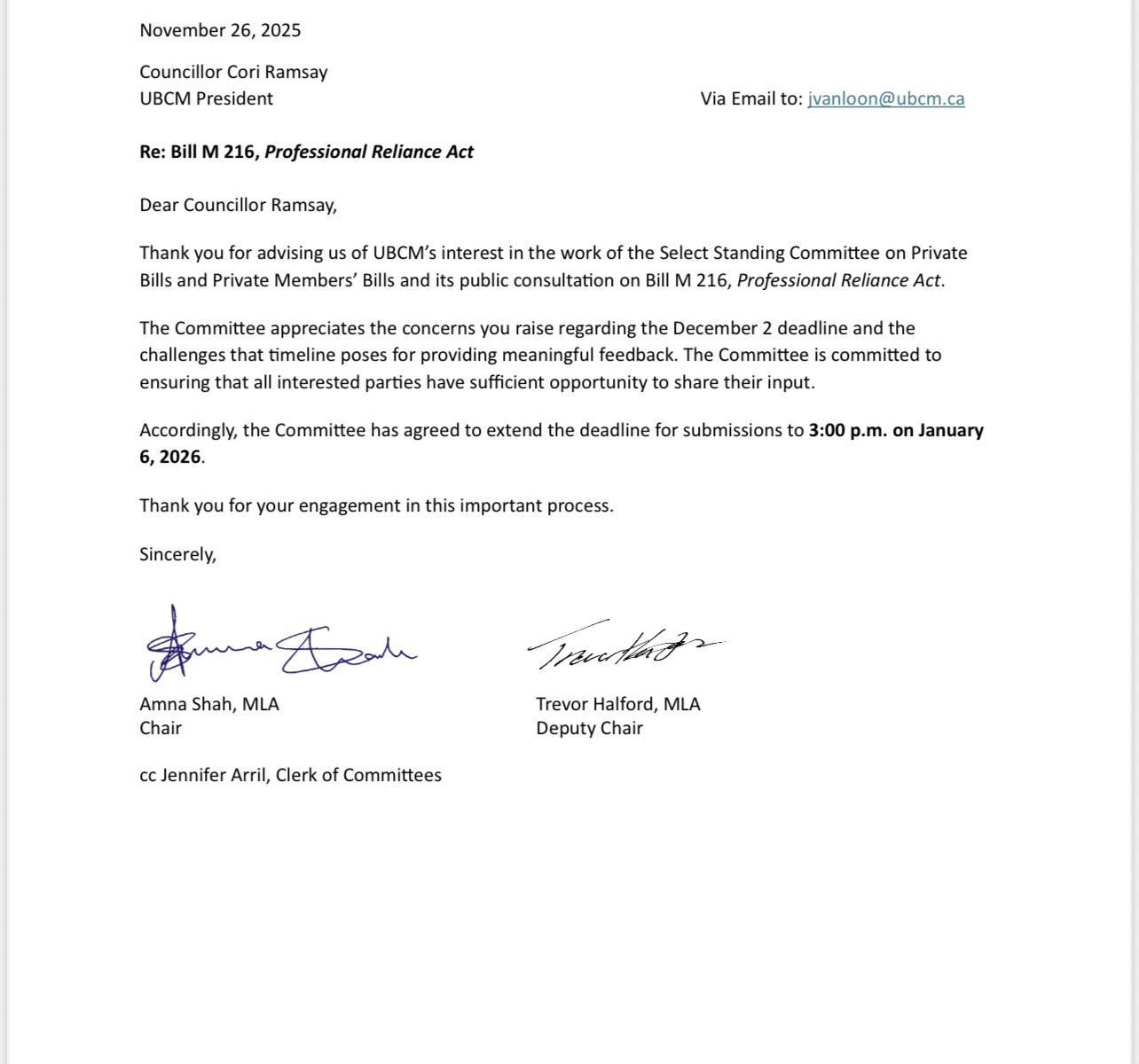
I’m glad to share with you that UBCMs requested extension has been granted for the feedback submission period on Bill M216 until January 6 at 3pm. My thanks to the Standing Committee for considering this request.

Local governments will be deeply impacted by this bill if it proceeds and I want to ensure everyone has time to voice their concerns and perspectives and be heard. That’s why I immediately asked for an extension upon seeding the Dec 2nd deadline, knowing it was not nearly enough time for councils and boards.

Thank you to everyone who has already shared their feedback with the Standing Committee and UBCM – and thank you to those local governments who are diligently working to get their submission in by the deadline.

For those who may not have considered a submission on this private members bill, I would encourage you to learn more about Bill M216 and the consider potential impacts to your local government.

UBCM has released several Compass articles now on Bill M216, including the recent article that came out this morning which can be found here.

If there’s been any confusion about my position on Bill M216, and if you’ve received emails with nuances that I’ve been consulted on this Bill, let me clear it up for the record: UBCM has not been consulted and I am opposed to Bill M216.

Here are a few reasons why:

  • the definition of a PGA professional differs from that of the Community Charter and in a Lidstone & Company legal bulletin, they say the following: “Note that ‘PGA professional’ is a far broader category than the Community Charter’s qualified professional and includes agrologists, science technologists, technicians,
    applied biologists, engineers, geoscientists, forest professionals, and architects. Planners are not included, and many classes of the proposed “PGA Professionals” under Bill M216 have no health and safety expertise regarding matters that would devolve to them under this Act.” I find the expansion of the definition and the allowance of additional professionals without life safety experience deeply concerning, and coupled with an ability to make submission we must accept will bring about significant unintended consequences.
  • Under section 3 of the Bill, developer paid PGA professionals may submit documents that are in contravention of local bylaws and the local government would have to accept documents that violate their own bylaws, or go through dispute resolution.
  • One intent is to remove liability from the local government but local governments will still be named in lawsuits and what happens when the qualified professional does not have the appropriate level of insurance to cover a claim, will local governments be on the hook?
  • Section 5 of the Bill removes the peer review function that exists now between local government planners and developers and would require local governments to do dispute resolution through a superintendent located in Victoria when there is a concern with a submission
  • A superintendents office in Victoria will backlog development and slow down permitting
  • This bill applies to more than zoning permits – and the Lidstone legal brief states: “Professional reliance also applies to building design and construction, subdivision,
    infrastructure design and construction, wildfire or hazard development permits,
    riparian protection, flooding/landslide protection, geotechnical site issues, and
    more.” Again, the peer review function serves a deeper purpose and removing this function with things such as riparian protection and wildfire development permits are on the line – this is removing essential checks and balances.
  • this bill has already passed second reading with zero consultation done with local governments and our input matters. Our staff are knowledgeable professionals with a deep understanding of the local context and excluding their expertise is a grave error in my opinion.
  • Professional reliance is something local governments can already do – if it’s right for the local context – and with proper checks and balances through the peer review process; this bill would move us backwards and regulate professional reliance making it mandatory removing local autonomy and decision making when it comes to land use

I encourage not just local governments, but any impacted stakeholders to utilize this additional time to provide a submission, utilizing the granted extension period. And please, continue to copy UBCM on your submissions so we have a deeper understanding of your views on this Bill.

With gratitude.

Provincial Budget 2025

Today I had the priviledge of attending the Provincial Budget Speech at the Legislature as the UBCM special guest for the Honourable Minister Brittny Anderson. Before I delve into my insights and thoughts on the provincial budget, I wanted to give an update of activities since January.

January

The first two months of the year have flown by so quickly. In January, the City of Prince George hosted the Natural Resources Forum with amazing turnout. Roughly 1,300 participants descended on our community which included many local and provincial government colleagues from across the Province. I was pleased that Premier Eby was able to join us to deliver remarks in person. Additionally, a number of Cabinet Ministers were also able to attend and give remarks.

In January the City of Prince George also deliberated our municipal budget. This was a lengthy debate of almost 18 hours on top of the additional hours each of us spent on our own time reviewing operating and capital budgets. Council settled on a 6.21% tax levy increase. I did write a draft blog on this but couldn’t find time to finalize and publish so I may still try to get that out.

February

February was just as busy with a UBCM executive meeting discussing local government advocacy priorities. Additionally, Council kicked off discussion of first and second reading for our Official Community Plan with the first public hearing scheduled for March 19.

March

This brings us to this first week of March. Yesterday, I had the pleasure of joining the FCM BC Caucus to discuss regional issues and hear from our local government colleagues. Many local governments are concerned over the tariffs and discussing how to prioritize local/regional/Canadian spending.

Provincial Budget

Today, I attended the Provincial budget as an observer from the members gallery. I have never been to a budget announcement so I wasn’t sure what to expect. First, UBCM staffers were included in the Budget Lock-Up – something I feel shows the importance of the relationship. This gave UBCM staff early access this morning to review the budget prior to the announcement which allowed them to publish The Compass immediately following the announcement. The only caveat was sacrificing phones and all technological devices until after the announcement.

I listened intently to Minister Bailey give her remarks and all the while wondering how each aspect of the budget she announced would impact local governments across the province.

Of note was the increased funding for HEART/HEARTH to support communities experiencing homelessness, funding for addiction, treatment and recovery, funding to address the healthcare shortage, as well as funding for community safety to address street disorder and repeat violent offenders. All these items are supported by UBCM resolutions many local governments have been advocating for. Finally, tariffs were a huge topic within the budget and we do not yet know how this will impact the province.

One item I do applaud Minister Bailey for advancing is investment in our tech sector which she has a strong background in. There is a great opportunity to advance tech and open up opportunity across the province (and yes, northern communities still have broadband issues which we bring up often). I am hopeful to see how this evolves.

The opposition was critical of the provincial deficit while also criticizing the government for not putting aside more than $4B in reserves to deal with the tariffs. The opposition also called upon the government to delay the budget given the tariff announcements today.

Following the budget announcement I was able to connect with Premier Eby, and Ministers Bailey and Anderson. I look forward to working with them all and others over the next year in my position on UBCM and on council to make progress on our collective and individual advocacy efforts.

How budget actually shakes out for local governments only time will tell. I for one will be keeping a close eye on the UBCM Compass and the Province to see what happens next.

The difference a vote can make

I was at the dog park this week speaking with a young 29 year old elector who told me he had absolutely no interest in voting. We chatted for a bit about the importance of getting out to vote but I couldn’t persuade him to participate because to him, one vote wouldn’t make a difference. It got me to thinking – how many local government elections are shaped by one vote – one elector?

I heard a story ages ago from the Mayor of the Northern Rockies Regional Municipality Mayor Gary Foster about his election to council in the 90s where he tied with the last place candidate. Both candidates went before a judge to make a determination and that judge drew names from a hat, and declared him the winner of the election. According to The Candidate’s Guide for Local Government Elections in BC, this is still a current practice and there are two ways to deal with a tie: drawing names from a hat, or doing a runoff ballot.

So going back to the question: does your vote really matter – can one vote really make a difference? I reviewed all the voting data from every local government election in 2018 and found some interesting examples that prove one vote really does make a difference.

Anmore, Burns Lake, Highlands, Keremeos, Lion’s Bay, Lytton, McBride, Midway, New Hazelton, North Saanich, Radium Hot Springs, Silverton, Telkwa, Trail, and Zeballos had councils where every candidate was acclaimed. One could argue that a single person putting forward their nominations papers could have produced an entirely different outcome in the election.

In Belcarra, the last place elected councillor won by just one vote, and in Armstrong, Cumberland, Gold River, Greenwood, Pouce Coupe, Powell River, Sparwood, and Squamish, the last place elected councillor won by just two votes. Those communities where the last place elected councillor won by less than 10 votes: Qualicum, Slocan, Hazelton, Merritt, Sicamous, Creston, Port Alice, Sayward, Logan Lake, Coquitlam, New Denver, and Barriere.

Here’s the full list ending with Nanaimo, which had the biggest spread between the last place elected councillor with a 2564 vote spread.

CommunityVote Difference
Anmore0
Burns Lake0
Highlands0
Keremeos0
Lion’s Bay0
Lytton0
McBride0
Midway0
New Hazelton0
North Saanich0
Radium Hot Springs0
Silverton0
Telkwa0
Trail0
Zeballos0
Belcarra1
Armstrong2
Cumberland2
Gold River2
Greenwood2
Pouce Coupe2
Powell River2
Sparwood2
Squamish2
Qualicum3
Slocan3
Hazelton4
Merritt4
Sicamous4
Creston5
Port Alice6
Sayward7
Logan Lake8
Coquitlam9
New Denver9
Barriere10
Fort St James12
Kent12
Stewart12
Wells14
Queen Charlotte15
Sooke16
Montrose18
Port Edward18
Port McNeill19
Salmo19
Clearwater20
Masset20
West Vancouver20
 100 Mile House21
Metchosin22
Sun Peaks22
Peachland23
West Kelowna23
Alert Bay25
Hudson’s Hope25
Cache Creek26
Duncan26
Fraser Lake26
Fruitvale26
Port Hardy27
Gansle29
Canal Flats32
Vanderhoof33
Grand Forks34
Dawson Creek35
Lantzville35
Ashcroft36
North Cowichan36
Fort St John37
Fernie38
Smithers38
Tahsis39
Clinton44
Princeton45
Oliver47
Mission49
Tofino51
Pemberton53
Tumbler Ridge53
Mackenzie55
Port Alberni57
Whistler59
Houston61
Lillooet61
Port Clements65
Valemount68
Coldstream69
Hope69
Terrace72
Gibsons77
Kitimat82
Campbell River84
Castlegar84
Rossland85
Courtnay89
Harrison Hot Springs90
Kaslo92
Maple Ridge92
Richmond97
Williams Lake97
Sechelt98
Ucluelet98
Enderby99
White Rock99
Lumby101
District North Vancouver101
Salmon Arm101
Langley103
Golden104
Revelstoke111
Warfield115
Invermere118
Chase120
Elkford125
Nakusp126
Ladysmith127
Colwood129
Chetwynd134
Kimberley135
Taylor136
City of North Vancouver137
Lake Cowichan151
Penticton151
Osoyoos163
Northern Rockies165
Prince Rupert165
Port Moody171
Quesnel176
View Royal187
Burnaby215
Langford236
Summerland259
Surrey261
Bowen Island286
Cranbrook292
Parksville311
Spallumcheen323
Nelson331
Comox365
Pitt Meadows374
Oak Bay398
Vernon407
Saanich424
Central Saanich432
Abbotsford482
Port Coquitlam565
Esquimalt571
Delta601
Prince George692
Kamloops732
Sidney763
Chilliwack814
Victoria1147
New Westminster1298
Kelowna1602
Vancouver1692
Nanaimo2564
Full dataset can be viewed here.

It might not seem like your vote makes a difference but it can and it does. So, this election, we have two more days of advanced voting opportunities and general voting day for you to get out and cast your vote. It very well could be the difference between your candidate getting elected or not.

Councillor Cori Ramsay seeking re-election in 2022 municipal election

August 31, 2022

Prince George, BC – Today, City of Prince George incumbent Cori Ramsay announced her intentions to seek re-election for the position of councillor in the 2022 municipal election. First elected in 2018, Ramsay has served the community as a strong advocate and collaborative leader for the last four years.

Over the course of the term Ramsay was appointed to the city’s Finance & Audit Committee, Accessibility Committee, and the Select Committee on Poverty Reduction. Additionally, Ramsay also ran for election to the North Central Local Government Association (NCLGA) board and during her time on the board (2019 – Present) became President (2021-2022) of the association representing 39 local governments across northern BC.

Last year, Ramsay was appointed to the Union of BC Municipalities (UBCM) Board, and currently sits on the Health and Social Development and Indigenous Relations Committees. She intends to run for election to the UBCM board this September at the associations Annual General Meeting (AGM).

Key priorities Ramsay hopes to focus on in the upcoming term include, but are not limited to:

  • Health and social well-being of our community, namely, the complex social issues impacting our community such as homelessness, mental health and addictions. 
  • Strategic and targeted advocacy 
  • Strong economic growth and resiliency
  • Infrastructure reinvestment
  • Art, culture, recreation, parks, trails, transit and green spaces
  • Truth and Reconciliation
  • Climate mitigation and adaptation

On running for re-election, Ramsay says this: “I will continue to work hard for the residents of Prince George. It is so important to have young voices and female representation around the council table and I hope you will vote for strong advocacy and collaborative leadership on October 15th as you head to the polls to cast your ballot.”

Cori Ramsay grew up living in poverty in the lower mainland and moved to Prince George at the age of 15 to come live with her Aunt and Uncle. She went on to study at UNBC, graduating with a English Literature degree in 2010. She complete her graduate diploma in public relations at UVIC in 2022 and currently works as Lead Marketing Analyst for Integris Credit Union.

To learn more about Cori Ramsay, visit coriramsay.ca.

-30-

Media Enquiries:

Cori Ramsay
250-613-2610
cori.ramsay@princegeorge.ca