
When we use our collective voices and come together in advocacy, we get results.
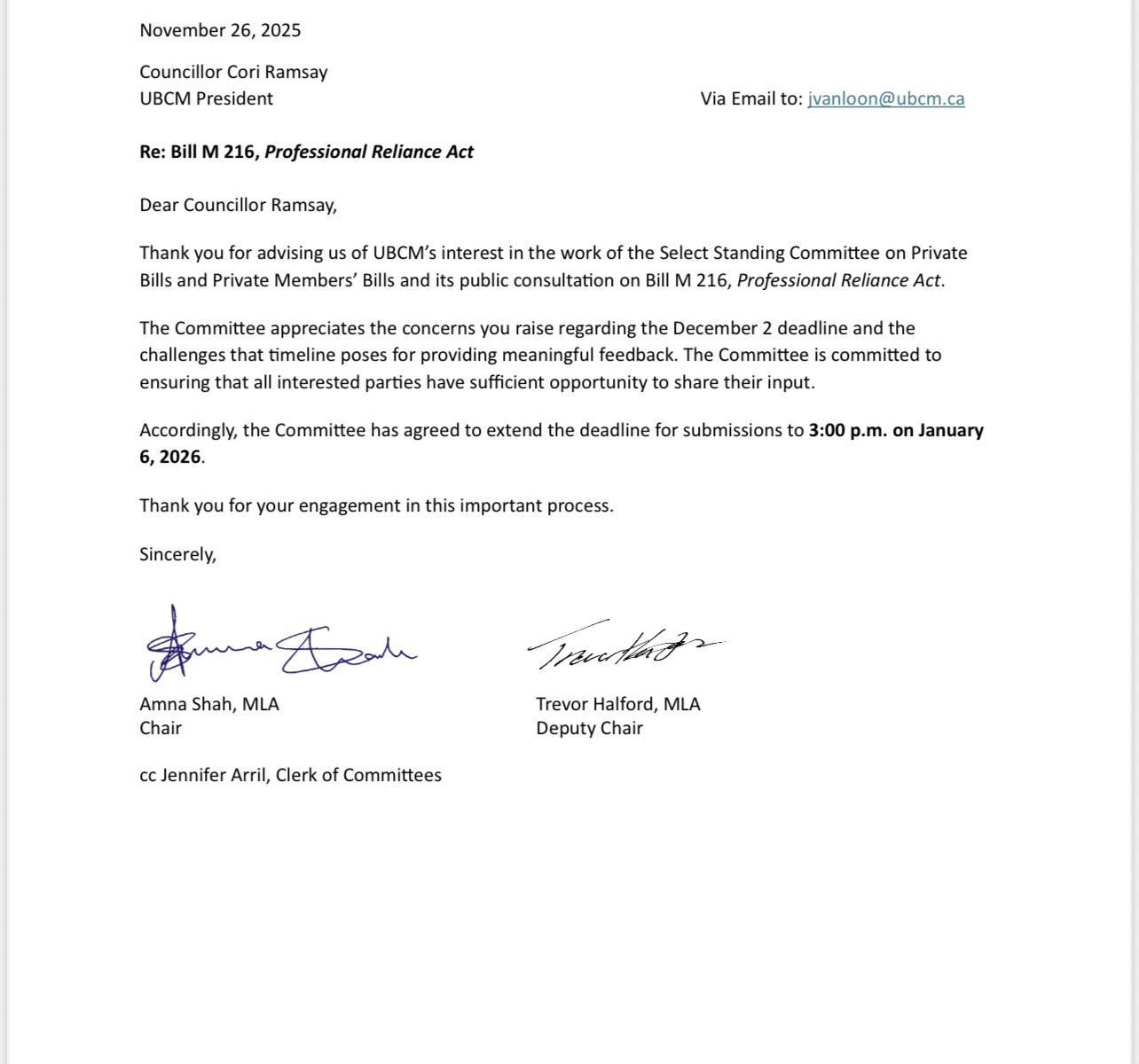
I’m glad to share with you that UBCMs requested extension has been granted for the feedback submission period on Bill M216 until January 6 at 3pm. My thanks to the Standing Committee for considering this request.

Local governments will be deeply impacted by this bill if it proceeds and I want to ensure everyone has time to voice their concerns and perspectives and be heard. That’s why I immediately asked for an extension upon seeding the Dec 2nd deadline, knowing it was not nearly enough time for councils and boards.
Thank you to everyone who has already shared their feedback with the Standing Committee and UBCM – and thank you to those local governments who are diligently working to get their submission in by the deadline.
For those who may not have considered a submission on this private members bill, I would encourage you to learn more about Bill M216 and the consider potential impacts to your local government.
UBCM has released several Compass articles now on Bill M216, including the recent article that came out this morning which can be found here.
If there’s been any confusion about my position on Bill M216, and if you’ve received emails with nuances that I’ve been consulted on this Bill, let me clear it up for the record: UBCM has not been consulted and I am opposed to Bill M216.
Here are a few reasons why:
- the definition of a PGA professional differs from that of the Community Charter and in a Lidstone & Company legal bulletin, they say the following: “Note that ‘PGA professional’ is a far broader category than the Community Charter’s qualified professional and includes agrologists, science technologists, technicians,
applied biologists, engineers, geoscientists, forest professionals, and architects. Planners are not included, and many classes of the proposed “PGA Professionals” under Bill M216 have no health and safety expertise regarding matters that would devolve to them under this Act.” I find the expansion of the definition and the allowance of additional professionals without life safety experience deeply concerning, and coupled with an ability to make submission we must accept will bring about significant unintended consequences. - Under section 3 of the Bill, developer paid PGA professionals may submit documents that are in contravention of local bylaws and the local government would have to accept documents that violate their own bylaws, or go through dispute resolution.
- One intent is to remove liability from the local government but local governments will still be named in lawsuits and what happens when the qualified professional does not have the appropriate level of insurance to cover a claim, will local governments be on the hook?
- Section 5 of the Bill removes the peer review function that exists now between local government planners and developers and would require local governments to do dispute resolution through a superintendent located in Victoria when there is a concern with a submission
- A superintendents office in Victoria will backlog development and slow down permitting
- This bill applies to more than zoning permits – and the Lidstone legal brief states: “Professional reliance also applies to building design and construction, subdivision,
infrastructure design and construction, wildfire or hazard development permits,
riparian protection, flooding/landslide protection, geotechnical site issues, and
more.” Again, the peer review function serves a deeper purpose and removing this function with things such as riparian protection and wildfire development permits are on the line – this is removing essential checks and balances. - this bill has already passed second reading with zero consultation done with local governments and our input matters. Our staff are knowledgeable professionals with a deep understanding of the local context and excluding their expertise is a grave error in my opinion.
- Professional reliance is something local governments can already do – if it’s right for the local context – and with proper checks and balances through the peer review process; this bill would move us backwards and regulate professional reliance making it mandatory removing local autonomy and decision making when it comes to land use
I encourage not just local governments, but any impacted stakeholders to utilize this additional time to provide a submission, utilizing the granted extension period. And please, continue to copy UBCM on your submissions so we have a deeper understanding of your views on this Bill.
With gratitude.
 coriramsay